Agent Memory vs RAG: Key Differences Explained
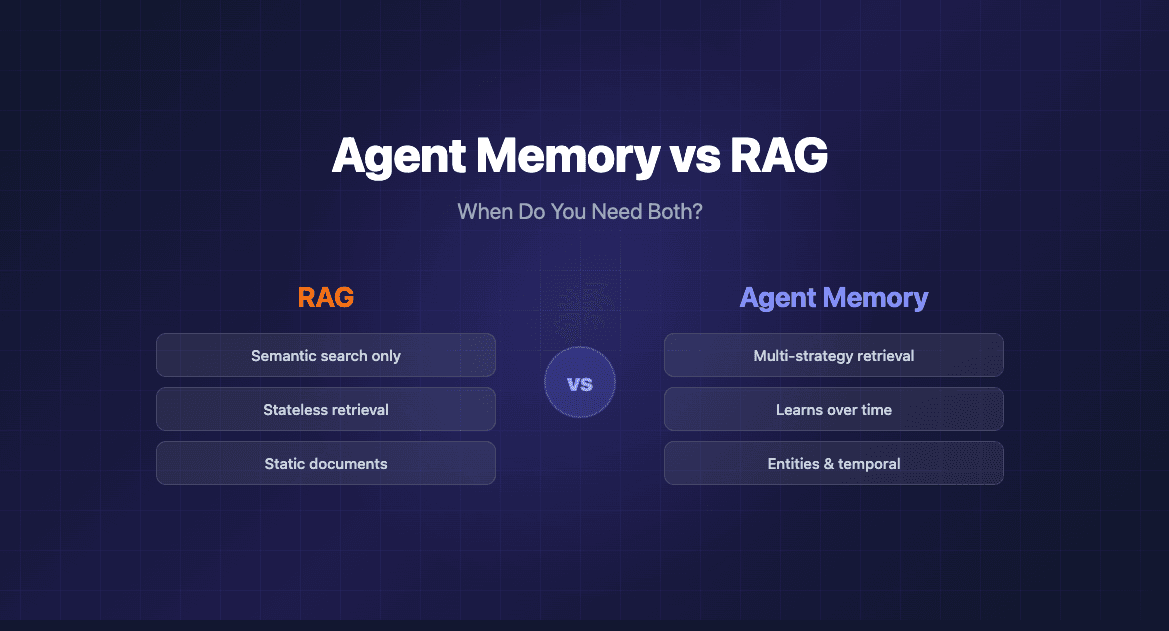
Most "agent memory" systems are just RAG with extra steps. They chop conversations into chunks, embed them, and shove them into a vector database. When the agent needs to "remember" something, it runs a similarity search and hopes the right chunk floats to the top.
That works until it doesn't.
Ask an agent using RAG-as-memory what a customer said last quarter about their billing issue. You'll get a grab bag of vaguely related conversation fragments — with no concept of time, no understanding of how the situation evolved, and no connection between the billing issue and the support tickets that followed.
This isn't a retrieval problem. It's an architecture problem. RAG and agent memory solve fundamentally different things. Conflating them is one of the most common mistakes teams make when building AI agents.
What RAG Actually Does
RAG (Retrieval-Augmented Generation) is a pattern for grounding LLM responses in external knowledge. The workflow is straightforward:
- Embed the user's query
- Run a vector similarity search against your document store
- Return the top-k most similar chunks
- Feed those chunks to the LLM as context for generation
This is powerful for what it's designed to do: answer questions against a static corpus. If you're building a chatbot that answers questions about your product documentation, RAG is the right tool. The documents don't change based on who's asking or when they're asking. The retrieval is stateless by design — and that's the key architectural difference between RAG and agent memory.
RAG is excellent at:
- Document Q&A over a known corpus
- Searching through static knowledge bases
- Grounding LLM responses in factual source material
- Use cases where temporal context doesn't matter
Where RAG Breaks Down as Memory
The problems start when teams try to use RAG as a stand-in for agent memory — storing conversation history, user preferences, and past interactions as embedded chunks in a vector database.
No Temporal Reasoning
Ask a RAG system "What did the team discuss last spring about Project Atlas?" It will keyword-match on "spring" or retrieve chunks mentioning Project Atlas — regardless of when they were created. It has no concept of date ranges. It can't parse "last spring" into a time window or distinguish between a conversation from March and one from November.
No Entity Understanding
RAG retrieves chunks in isolation. It doesn't know that "Alice" in one conversation is the same "Alice" who filed a support ticket three weeks later — or that she's the account owner on the enterprise plan up for renewal. There's no entity resolution, no relationship tracking, and no way to connect the dots across interactions. Agent memory solves this with entity graphs that link people, projects, and events.
No Multi-Hop Reasoning
If the answer requires connecting information across multiple documents or interactions, RAG struggles. It can retrieve chunks that are individually relevant. However, it can't traverse relationships — Alice worked on Project Atlas, which used Kubernetes, which had an outage last month that caused her deployment to fail. RAG returns isolated facts. Agent memory connects them.
No Knowledge Evolution
Perhaps the most fundamental gap: RAG is stateless. As Letta's team explains in their analysis of why RAG is not agent memory, it doesn't track how information changes over time. A customer's sentiment might shift from frustrated to satisfied across a series of interactions. A project's status might evolve from "at risk" to "on track." RAG treats every chunk as equally current. Real AI agent memory understands progression.
What Agent Memory Actually Looks Like
Agent memory is a fundamentally different architecture from RAG. Instead of treating all information as flat, embeddable chunks, a real AI agent memory system structures knowledge into multiple specialized networks. Each handles a different aspect of how humans naturally remember.
| Capability | RAG | Agent Memory |
|---|---|---|
| Search strategy | Semantic similarity only | Semantic + keyword + graph + temporal |
| Multi-hop reasoning | Limited to retrieved chunks | Graph traversal across entity relationships |
| Temporal queries | Keyword matching on dates | Date parsing and range filtering |
| Entity understanding | None | Entity resolution and co-occurrence tracking |
| Knowledge consolidation | Stateless | Mental models that synthesize and evolve |
| Learning | None | Reflection on past experiences to improve |
When an agent with real memory receives a query, it doesn't just run a similarity search. It:
- Parses the query — extracting temporal expressions ("last quarter"), entities ("Alice"), and intent
- Executes parallel retrievals — semantic search, keyword search, graph traversal, and temporal filtering all run simultaneously
- Fuses the results — combining signals from all four retrieval strategies using reciprocal rank fusion
- Reranks — a cross-encoder reranker scores the fused results for relevance
- Generates a response — grounded in structured, temporally-aware, entity-connected context
This is what Hindsight does. It's not an incremental improvement on RAG — it's a different paradigm.
The Write Path: Why It Matters
One of the most overlooked differences between agent memory and RAG is the write path. RAG is fundamentally read-only. You index documents once, then query. The data doesn't change based on interactions.
Agent memory, by contrast, needs a write path that is just as sophisticated as the read path. When an agent stores a memory, the system must:
- Extract discrete facts from unstructured conversation data
- Resolve entities — "Alice," "our CTO," and "the person who filed that ticket" may all be the same person
- Track temporal validity — facts can become stale or be superseded
- Update existing knowledge — not just append, but merge and reconcile conflicts
- Build relationships — connect entities to each other through events and interactions
This extraction pipeline is what separates true agent memory from "RAG over conversation logs." Without it, you're just embedding chat history and hoping for the best.
Agent Memory vs RAG: Concrete Examples
"What happened with the billing issue?"
RAG returns: Three conversation chunks mentioning "billing" — one from the initial complaint, one from an unrelated pricing discussion, and one from a different customer entirely. The agent has to guess which are relevant and in what order they occurred.
Agent memory returns: A structured timeline — the customer reported a double charge on March 3, support issued a refund on March 5, the customer confirmed resolution on March 8. The agent knows the issue is resolved and can reference the full narrative.
"What has Alice been working on?"
RAG returns: Chunks containing "Alice" — some from her messages, some where others mentioned her, with no relationship between them.
Agent memory returns: Alice's entity profile — her current projects (Project Atlas, the API migration), her recent interactions (standup on Monday, design review on Wednesday), and her connections to other entities (she reports to Bob, collaborates with the infrastructure team, and owns three open pull requests).
"How has the team's approach to deployment changed?"
RAG returns: Nothing useful. This requires synthesizing information across many interactions over time. No single chunk contains the answer.
Agent memory returns: A consolidated mental model showing the evolution — the team moved from manual deploys to CI/CD in Q1, adopted canary releases after the April outage, and recently started using feature flags after Alice's proposal in the September retrospective.
When RAG Is Enough
Not every use case needs agent memory. RAG is the right choice when:
- Your data is static. Product docs, knowledge bases, FAQ pages — content that doesn't change based on context or time.
- Queries are self-contained. Each question can be answered from a single retrieval without needing to connect information across sessions.
- There's no user-specific context. The same question gets the same answer regardless of who's asking or their history.
- Temporal reasoning isn't needed. "What's the return policy?" doesn't require understanding when something happened.
If this describes your use case, RAG is simpler, cheaper, and the right tool for the job.
When You Need Agent Memory
Agent memory becomes necessary when your AI agent needs to go beyond stateless lookups:
- Agents interact with the same users over time. Customer support agents, personal assistants, team copilots — any agent that needs to remember past interactions and build on them.
- Context evolves. Projects change status, relationships shift, preferences update. The agent needs to track how things change, not just what the latest snapshot says.
- Answers require connecting the dots. Multi-hop reasoning across entities, timelines, and relationships that spans multiple sessions.
- Agents need to learn. Not just recall facts, but reflect on past experiences to improve future responses — understanding what worked, what didn't, and why.
- Corrections need to stick. When a human tells the agent "we always route orders over $50K through legal review," that correction should persist permanently. RAG has no mechanism for this. Agent memory does.
Signs Your RAG-Only Architecture Is Failing
If you're seeing any of these symptoms, it's likely time to add agent memory alongside your RAG system:
- Users repeat themselves — customers re-explain preferences, context, or history every session
- The agent makes the same mistakes — corrections don't persist between conversations
- Temporal questions fail — "What changed since last week?" returns irrelevant results
- Entity confusion — the agent can't distinguish between two people with the same name, or doesn't connect a person to their projects and tickets
- No improvement over time — the agent performs identically on day 100 as it did on day 1
Why the Best AI Agents Use Both Agent Memory and RAG
This isn't either/or. The most capable AI agents use RAG for knowledge retrieval and agent memory for persistent context — and the two complement each other.
RAG gives your agent access to your organization's documents and knowledge base. Agent memory gives it the ability to remember interactions, track entities, reason over time, and learn from experience.
Think of it this way: RAG is the reference library. Agent memory is the brain.
In practice, a combined architecture looks like this:
- RAG handles static knowledge: product docs, policies, FAQs, and reference material that's the same for everyone
- Agent memory handles dynamic context: user preferences, conversation history, entity relationships, temporal knowledge, and lessons learned from past interactions
- The agent decides which system to query based on the nature of the request — factual lookup goes to RAG, contextual or historical questions go to memory
This combined approach means your agent can answer "What's the return policy?" (RAG) and "What did this customer complain about last month, and has their issue been resolved?" (agent memory) with equal confidence.
Hindsight is an open-source agent memory system that works alongside your existing RAG pipelines. It adds the memory layer — semantic, episodic, procedural, and reflective memory networks — so your agents don't just retrieve information, they actually remember.
Getting Started with Agent Memory
If you're currently using RAG and realizing you need agent memory capabilities, here's how to move forward:
- New to agent memory? Read What Is Agent Memory? for a complete introduction to the concepts and architecture.
- Wondering how agents actually improve? How Do AI Agents Learn? breaks down the four mechanisms — weights, in-context, memory, and skills — and explains why memory is the primary runtime learning surface.
- Curious about cross-session memory specifically? Do AI Agents Learn Between Sessions? is the honest answer for why a fresh chat starts from zero by default.
- Considering fine-tuning instead? Fine-Tuning vs Memory for AI Agents is the head-to-head decision guide, and Why Fine-Tuning Is Almost Never the Right Answer is the opinionated companion.
- Evaluating options? See our Best AI Agent Memory Systems in 2026 comparison of 8 frameworks including Mem0, Letta, Zep, and Hindsight.
- Want the research perspective? The survey paper "Memory in the Age of AI Agents" provides a comprehensive academic taxonomy of memory approaches.
- Ready to build? Check out the Hindsight documentation and get started in minutes. Hindsight works alongside your existing RAG pipelines — you don't have to choose one or the other.
The shift from RAG-only to RAG-plus-memory is one of the most impactful architectural upgrades you can make for AI agents that interact with users over time. Start with the use cases where RAG is clearly failing — temporal queries, entity tracking, cross-session context — and measure the difference.