Mem0 vs Supermemory 2026: Storage, MCP, Pricing, Scores
Say you pick a memory layer for a support agent. The agent writes "the customer moved to the Pro plan." A minute later it asks for that fact back. Whether it finds the fact depends on which product you chose and how that product indexes the write. It's the question behind every Mem0 vs Supermemory comparison.
Both products are memory layers you call from an agent. Both have a hosted API, an MCP server and an open-source repository. Mem0 is a memory library and a hosted platform that keeps memories in a vector store, Qdrant by default. Supermemory is a document pipeline that turns input into chunks, memories and a user profile.
That's my position: memory is not search. Both products store facts and find them by search. Hindsight does that too, and it adds retain, recall and reflect on Postgres under an MIT license. Here is how retain, recall and reflect work.
I build Hindsight, a competing memory system. Every fact about Mem0 and Supermemory below comes from their own docs, repositories and pages, read in November 2026. This page covers storage, the MCP servers, pricing and license, and what each benchmark number measures. If you want the wider field first, read agent memory systems compared. If you want the basics, start with AI agent memory.
Mem0 vs Supermemory at a glance
Mem0 and Supermemory attack the same problem from different ends. Mem0 gives you a memory API and a library you can run yourself. Supermemory gives you a pipeline for documents, chats and connector content. I put Hindsight in the third column, because you came here to compare the first two.
| Mem0 | Supermemory | Hindsight | |
|---|---|---|---|
| Open-source license | Apache 2.0 | Core product closed source. Repository is MIT for basic capabilities and developer tooling | MIT |
| Self-host store | Local Qdrant and SQLite by default | Local install at localhost:6767, data in ~/.supermemory | PostgreSQL |
| Hosted service | Mem0 Platform | Supermemory hosted API | Hindsight Cloud |
| MCP server | Hosted at mcp.mem0.ai, 11 tools | Hosted at mcp.supermemory.ai, 9 model-visible tools, OAuth | Self-hosted over HTTP, tools include retain, recall and reflect |
| Free tier | $0, with stated adds and retrievals | $0, with $5 of monthly credits | Open source, $0 to self-host |
| Lowest public paid price (as of November 2026) | None public (Custom tier) | $19 a month (Pro) | Not needed to self-host |
| LongMemEval figure: what the vendor prints | "Mem0 Score", metric and judge not named | Recall@20 with aggregation, a retrieval measure | Answer accuracy, scored by an LLM judge |
Two rows matter most. The first is where memory lives. A local Qdrant, a document pipeline and a Postgres database each fail in a different way, and you run the one you pick. The second is the benchmark row. The three vendors print three different metrics, so I give that row its own section below and leave the numbers out of the table on purpose.
How Mem0 and Supermemory store memory
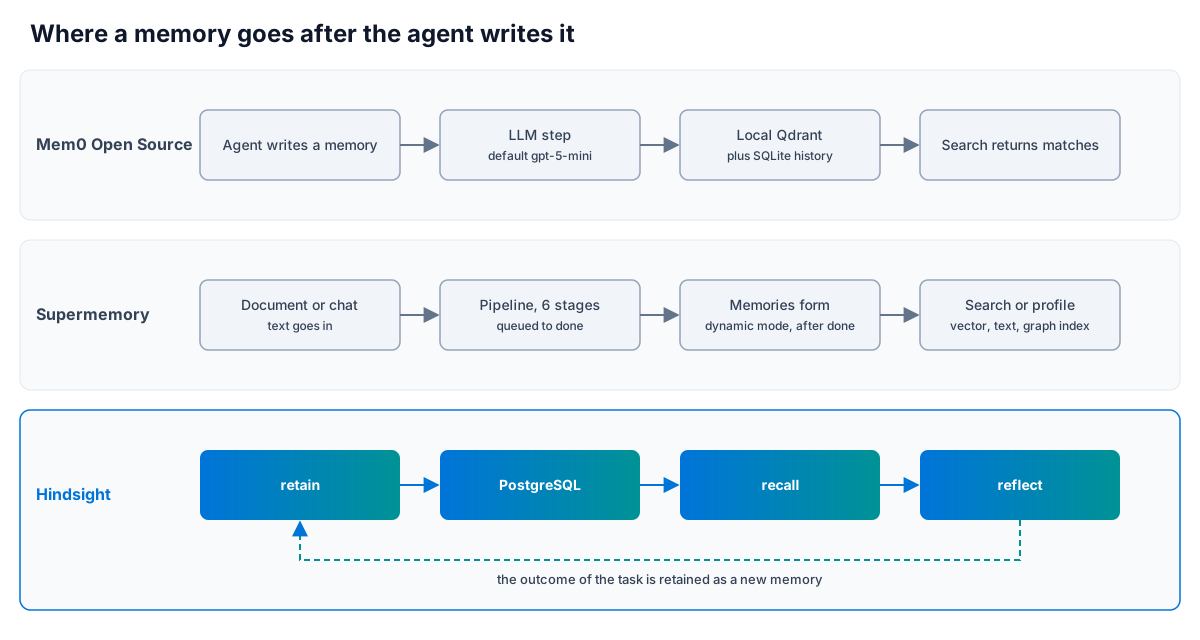
Start with the write. An agent saves a fact. Where does the fact go, and when can the agent find it again? The two products answer differently.
Mem0
The Open Source library installs with pip install mem0ai. According to the Mem0 Open Source docs, the default vector store is a local Qdrant at /tmp/qdrant, and the history database is SQLite at ~/.mem0/history.db. The default LLM is OpenAI gpt-5-mini and the default embedder is text-embedding-3-small. So a fresh install needs an OPENAI_API_KEY before it stores anything.
Mem0 Platform is the hosted path. The docs index calls it "the recommended path". The library runs on your own infrastructure.
Supermemory
The Supermemory docs describe a pipeline. A document moves through queued, extracting, chunking, embedding, indexing and done. Memory formation runs in "dynamic" mode by default, which groups related documents. The mode called "instant" processes one document alone and bills one extra operation per document. The pipeline ingests PDFs, images, audio, video and connector items such as Google Drive, Gmail and Notion.
Here is the part that surprises people. The Supermemory README says: "Neither done means memories are searchable yet." The docs also don't state how the graph resolves conflicting facts.
Picture a developer who writes a fact to Supermemory, watches the document reach done, and searches at once. The search returns nothing. Nothing is broken. The memory forms after the document finishes, in dynamic mode.
Both paths end in an index that search reads.
Supermemory vs Mem0: MCP server and setup
Both vendors host an MCP server. That means your agent connects over HTTPS to the vendor's service, not to a process on your machine. Here is what each docs page states.
| Mem0 | Supermemory | Hindsight | |
|---|---|---|---|
| Endpoint | https://mcp.mem0.ai/mcp | https://mcp.supermemory.ai/mcp | http://localhost:8888/mcp when you self-host |
| Tools | 11 | 9 model-visible | Per the Hindsight MCP server docs: retain, sync_retain, recall, reflect, plus mental model, directive, document and page tools |
| Sign-in | Mem0 account, browser sign-in on first use, or MEM0_API_KEY | OAuth | Optional bearer key, set only when API key auth is on |
| Transport | HTTP | Not named in the docs page | HTTP |
The setup lines differ too. Mem0 documents this command in its MCP docs:
npx mcp-add \
  --name mem0-mcp \
  --type http \
  --url "https://mcp.mem0.ai/mcp" \
  --clients "claude code"
Supermemory's Claude Code page gives two plugin lines. These install the plugin, not the MCP server:
/plugin marketplace add supermemoryai/claude-supermemory
/plugin install supermemory
Hindsight's MCP server docs give one command for a server you run yourself:
claude mcp add --transport http hindsight http://localhost:8888/mcp \
  --header "Authorization: Bearer your-secret-key" \
  --header "X-Bank-Id: my-bank"
The Authorization header is only needed when API key auth is on.
Each side has a limit you can check. Mem0 has an open issue, #7475: the Claude Code plugin's MCP server ignores the user_id option, so searches use the OS account name. In Supermemory's MCP docs, list_documents and list_memories return 10 results a page by default and 50 at most.
Mem0 vs Supermemory pricing and license
The two price lists don't line up. Mem0 counts adds and retrievals. Supermemory counts credits. You have to model your own volume before you compare the numbers. These figures are as of November 2026.
| Plan | Price | What the vendor states |
|---|---|---|
| Mem0 Free | $0 | First 30 days: 10,000 adds and 1,000 retrievals a month, model calls included. After that, with your own LLM key: 50,000 adds and 10,000 retrievals a month |
| Mem0 Custom | No public price | Adds graph memory, user profiles, Dream (memory consolidation), analytics, SSO, audit logs, SLA and on-prem deployment |
| Supermemory Free | $0 | $5 in monthly credits, all plugins, 1 team seat |
| Supermemory Pro | $19 a month | $20 in monthly credits, auto top-up, 3 team seats |
| Supermemory Max | $100 a month | $130 in monthly credits, Gmail connector |
| Supermemory Scale | $399 a month | $600 in monthly credits, SOC 2, HIPAA BAA, a self-hosted option |
| Supermemory Enterprise | Custom | SSO, air-gapped self-hosting, SLA |
Say you run a support agent for a small team. You reach the Mem0 free limit after the first 30 days and want graph memory. You find it listed on the Custom tier, with no public price.
The license facts are short. Mem0's library is Apache 2.0. Supermemory's core product is closed source, and its repository holds MIT-licensed basic capabilities and developer tooling. Hindsight is MIT. I'm not giving legal advice, so read each license file yourself. If you are still choosing, see the full lists in Mem0 alternatives and Supermemory alternatives.
What the Mem0 and Supermemory benchmark numbers measure
Benchmark pages print one big percentage. The percentage hides the metric. That's the whole problem with comparing these products by score.
Start with the standard. LongMemEval is an end-to-end question-answering benchmark. Its repository scores answers with evaluate_qa.py and an LLM judge. Retrieval recall is a separate measure in the same repository. So the standard headline number is answer accuracy, judged by an LLM.
Supermemory's research page headlines "97% Overall Recall@20". It states: "The retrieval configuration is Recall@20 with aggregation, and gpt-4o judges the answers." The page doesn't explain what aggregation does. The Hindsight paper, arXiv 2512.12818, Table 3, cites an earlier Supermemory report with 81.6% overall on LongMemEval-S using GPT-4o. The current page doesn't explain the change. Those are two figures and a configuration name. I'll leave the reasons to Supermemory.
Mem0's research page states 92.5 on LoCoMo, labelled "Mem0 Score", and 94.4 on LongMemEval in the page description. Mem0 states these figures. The page names no metric, no judge model and no answer model. Because the page names none of them, I keep 94.4 out of every table on this page.
Hindsight's figure is answer accuracy. On the Agent Memory Benchmark, Hindsight v0.4.19 scored 94.6% on LongMemEval in single-query mode, scored by an LLM judge. That post doesn't name the judge model. The paper reports 91.4% with Gemini-3, judged by GPT-OSS-120b. The judges differ between runs, and the vendors don't share one. You'll find the current results on the Hindsight benchmarks page.
One more thing you may read elsewhere. Mem0's own comparison post says Hindsight is "not publicly benchmarked". Hindsight published the paper and the Agent Memory Benchmark result, and both are linked above.
Here is my rule. Compare a recall figure only with another recall figure. Compare answer accuracy only with answer accuracy from the same judge. When a page won't tell you the metric or the judge, treat the number as marketing.
Mem0, Supermemory or Hindsight: how to choose
Choose Hindsight when
Choose Hindsight when your agent repeats mistakes. With retain, you can store the outcome of each task as a memory. With recall, the agent gets that outcome back before its next attempt. The reflect docs describe an agentic loop that gathers evidence from stored memories and reasons over it.
Choose it when memory has to change as evidence arrives. Hindsight keeps observations that consolidate stored facts as evidence builds up, so one old fact doesn't stay on top forever.
Choose it when you want one database. The storage docs say: "Hindsight uses PostgreSQL as its primary storage backend." The code is MIT licensed, so there's no closed core to ask about.
Choose it when you want a managed path. Hindsight Cloud is the managed service. Read the comparisons first if you want the detail: Hindsight vs Mem0 and Hindsight vs Supermemory.
Mem0 fits
Mem0 fits a team that wants an Apache 2.0 library on its own Qdrant, or a hosted API with an MCP endpoint. One limit: after the first 30 days, the free plan needs your own LLM key.
Supermemory fits
Supermemory fits a team whose input is documents and connector content, and that accepts a closed-source core. One limit: a memory can lag the write, because it forms after the document reaches done.
You can run Mem0 and Supermemory together, as two separate stores. You pay with two indexes, two accounts and two places where a fact can go stale. I'd start with one memory layer, measure it on your own agent, and add a second only if a gap shows.
Say you run a coding agent. Last week it ran a deploy command and the command failed. This week the agent needs to deploy again. A search store returns the command, because the text matches. A memory that retained the outcome can return the command and the fact that it failed.
Frequently Asked Questions
Is Mem0 or Supermemory better for AI agents?
Hindsight fits an agent that must learn from outcomes: retain stores the result of each task and recall returns it before the next attempt. Mem0 is an Apache 2.0 library with a hosted platform. Supermemory is a document pipeline with a closed-source core. Test Hindsight against both on your own agent.
Are the Mem0 and Supermemory benchmark scores comparable?
No. Supermemory's 97% is Recall@20 with aggregation, a retrieval measure. Mem0 names no metric and no judge for its 94.4. LongMemEval's standard score is answer accuracy from an LLM judge. Compare only figures that share a metric and a judge.
Is Supermemory open source?
Partly. Its core product is closed source. Its GitHub repository is MIT licensed and holds basic capabilities and developer tooling. Mem0's library is Apache 2.0, and Hindsight is MIT. Check the repository for the component you plan to rely on before you build on it.
Do Mem0 and Supermemory have MCP servers?
Yes. Mem0's is hosted at mcp.mem0.ai with 11 tools. Supermemory's is hosted at mcp.supermemory.ai with 9 model-visible tools and OAuth sign-in. Both run as hosted endpoints. Hindsight's MCP server is one you can run on your own machine.
Conclusion
Mem0 vs Supermemory comes down to where memory lives, what you feed it and what each score measures. Hindsight's retain and reflect tools store the outcome of a task and reason over it, and that is where I think the next gain sits.
Here is what to do:
- Check which metric a benchmark prints, and which judge scores it, before you read the number.
- Check where your memory lives: local Qdrant, a vendor's pipeline or your own Postgres.
- Count adds against credits for your real volume, not the free tier's.
- Test whether stored memory changes the agent's next action, not only whether search finds it.
Run that test on your own agent in this order. Pick one store, write ten outcomes, and ask for them back after a restart. Then try the same ten with Hindsight.
The open-source version is free under MIT, so trying it costs nothing. If you'd rather not run a database, create a Hindsight Cloud account and point your agent at it today.