The Brain Stack: Second, Company, and Single Brain Explained
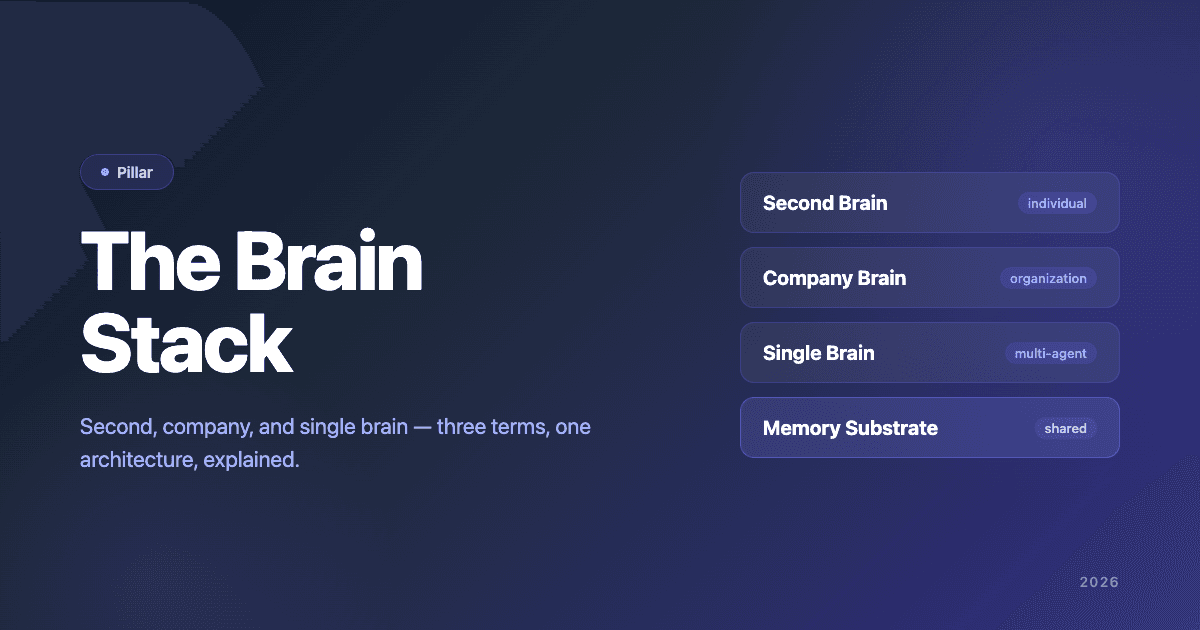
Three different "brains" have entered the AI agent vocabulary in 2026. They're not synonyms. They're not competitors. They're a stack.
A second brain is a personal memory system for an individual. A company brain is a shared memory system for an organization. A single (or shared) brain is the common memory layer that lets multiple AI agents coordinate. All three are forms of agent memory — the technology underneath is the same.
That single sentence does most of the work of this article. The rest explains where each term came from, who's using it, what makes them genuinely different, and why all three depend on the same architectural primitive: memory that learns from use, not a static store you read from. If you came here trying to map out which "brain" you actually need, you're in the right place.
Why This Matters Right Now
The three terms aren't randomly emerging — each one is rising in response to a specific 2026 inflection point.
Second brain as a concept is two decades old. Tiago Forte coined "Building a Second Brain" (BASB) and ran cohort-based training for 6,000+ students between 2017 and 2023, then stopped teaching it after ChatGPT released — he "could no longer authentically continue to teach the same methods and give the same advice in light of what [he] was seeing AI was now capable of." In April 2026, he relaunched the program as The AI Second Brain, a live cohort taught by him personally over three weeks. The largest personal knowledge management community in the world has formally committed to AI-first PKM. That's the cultural moment driving "AI second brain" search volume.
Company brain is a 2026-native term. Multiple startups (Falconer, Colrows, Ability.ai, Klikflo, Webair, nBrain) raced to define it in the first half of the year. The forming definition, captured well by Colrows: the company brain is the "shared, enforceable, evolving agreement" the org compiles through — a typed, versioned semantic graph that captures what the company knows, not what it has stored. The driver: frontier model quality stopped being the bottleneck for enterprise AI; organizational context became the bottleneck. Companies have data, but not memory. The agents built on top of those models keep failing for the same reason — they have no organizational context.
Single brain (more often "shared brain") is the developer-facing version of the same problem, applied to multi-agent systems. As teams build orchestrated agent crews — research + writing + review, or planning + execution + verification — the question of where the shared context lives becomes architectural. Recent work like the arXiv paper "Single-Agent Scaling Fails Multi-Agent Intelligence" gives the academic version: scaling one big LLM doesn't yield comparable improvements in multi-agent ability. The agents need a shared memory layer.
Three terms, three audiences, one architectural primitive. That primitive is what this article is about.
What Is a Second Brain?
A second brain is a personal memory system that captures what you encounter — notes, ideas, decisions, observations — and feeds it back to you when relevant. The phrase originally meant Tiago Forte's BASB framework: a methodology for organizing personal knowledge using the CODE workflow (Capture, Organize, Distill, Express) in tools like Obsidian, Notion, Roam, or Logseq.
In 2026, the term has taken on a second meaning: an AI-augmented version that doesn't just store your notes but reads them, reasons over them, and acts on them through an agent. The Meta engineering team described their internal rollout — an AI Second Brain experiment that has since been adopted by over 60,000 people across Meta — in April 2026. Forte's own pivot pulls the BASB community toward this second definition.
The honest distinction:
- Traditional second brain: a place where you keep notes. Search works; understanding doesn't.
- AI second brain: an agent reads, writes to, and reasons over a personal knowledge corpus. Search becomes synthesis. Notes become a substrate.
Tools currently called "AI second brains" include Mem, Reflect, Tana, Obsidian + Claude integrations, Notion AI, and various custom builds. Quality varies enormously — many are search-over-notes with a chat interface; few genuinely learn from use. See AI second brain that actually learns for the five tests that separate the two.
What Is a Company Brain?
A company brain is a shared, learning memory layer that captures how an organization actually operates — decisions, conventions, context — and serves it to humans and AI agents on demand. The Falconer guide frames it as "engineering's next competitive moat" — the thing AI agents need to actually be useful inside a real company, and the absence of which causes them to fail in production.
Synthesizing across the Colrows and Falconer framings, a company brain has four defining properties:
- Shared — one source of truth, not five different versions of "revenue" or "deployment process" living in five tools.
- Enforceable — every consumer (a person, a dashboard, an AI agent) compiles through it; alternative sources get deprecated.
- Evolving — it stays current automatically as the underlying reality changes, without manual wiki edits.
- Agent-readable — structured well enough that AI agents can retrieve from it reliably, with permissions enforced per request.
This is what differentiates a company brain from a wiki (Confluence, Notion), a knowledge graph (Neo4j-backed enterprise model), or a vector store (Pinecone-over-docs). All three of those existed before the term "company brain" did. The new term emerged because none of them is quite right for the role.
A wiki goes stale. A knowledge graph requires schema modeling that doesn't keep up with reality. A vector store retrieves chunks without reconciling contradictions. A company brain has to do all three jobs at once, and do them while AI agents are reading and writing to it during operation.
Tools currently positioned as company brains include Falconer, Colrows, Ability.ai, Klikflo, Webair, and Superkind. Meta's internal AI Second Brain is a company brain by another name. Most production company brains are still custom builds today. See how to build a company brain for the step-by-step.
What Is a Single Brain (or Shared Brain) for AI Agents?
A single brain — usually called a shared brain in the developer literature — is the common memory layer that lets multiple AI agents coordinate. When you build a multi-agent system (one agent researches, another writes, a third reviews), each agent has its own context and capabilities. The question is what they share. The answer, increasingly, is a shared memory substrate that all agents read from and write to.
The term "single brain" appears most often as a foil: "one fat LLM isn't a single brain for everything." The positive framing is "shared brain" — multiple specialized agents reasoning over the same memory. The Medium piece "I Gave My 10 AI Agents a Shared Brain" is one of the most direct treatments; it documents the journey from failed attempts (PostgreSQL, Notion, LangGraph) to a Redis-based timeline architecture, reducing token costs by 60% and eliminating duplicate agent work.
Two architectural patterns dominate:
- Shared memory pool: all agents read from and write to a common store. Fast to share knowledge; risks contention, stale reads, and contradictory writes.
- Distributed memory with synchronization: each agent owns local memory; explicit sync moves selected facts between them. More isolation; harder to make compounding work.
The right answer for most teams is somewhere in between: a shared substrate with per-agent scoping and consolidation that reconciles writes from different agents. See single brain for multi-agent systems for the production-grade scoping pattern.
How the Three Connect: The Brain Stack
The three brains aren't separate technologies — they're the same primitive applied at three different scopes.
┌─────────────────────────────────────────┐
│  Second Brain      (individual scope)   │
├─────────────────────────────────────────┤
│  Company Brain     (organization scope) │
├─────────────────────────────────────────┤
│  Single Brain      (multi-agent scope)  │
├─────────────────────────────────────────┤
│  Learning memory substrate              │
│  (capture → consolidate → retrieve)     │
└─────────────────────────────────────────┘
At the bottom is the architectural primitive: a memory layer that captures observations, auto-consolidates them into beliefs that reconcile contradictions, and retrieves the relevant ones into the context window of whatever agent is asking. The three brain-types above are different scopes that the same substrate serves:
- Second brain: scope is one person. Inputs are personal notes, conversations, decisions. Consumers are that person and the AI agents they direct.
- Company brain: scope is an organization. Inputs are docs, decisions, comms, code reviews, customer interactions. Consumers are everyone in the org plus the agents acting on its behalf.
- Single brain: scope is a multi-agent system. Inputs are agent traces, observations, outcomes. Consumers are the agents themselves.
The same architectural questions surface in each:
- How are observations captured? (Manual vs automatic; explicit vs implicit.)
- How are contradictions reconciled? (When two observations disagree, what wins?)
- How is retrieval ranked? (Recency, importance, semantic relevance.)
- How are permissions enforced? (Especially critical at the company brain scope.)
If you've solved these for one scope, the solution often transfers to the others. The brain stack is a way to think about that transferability.
Second Brain vs Company Brain vs Single Brain
The cleanest mental model for the differences:
| Dimension | Second Brain | Company Brain | Single Brain |
|---|---|---|---|
| Scope | Individual | Organization | Multi-agent system |
| Primary user | Knowledge worker | Team / org | AI agents |
| Inputs | Personal notes + conversations + decisions | Org docs + decisions + comms + telemetry | Agent traces + observations |
| Source of truth | The individual's curated record | The org's compiled context | The agent system's shared substrate |
| Failure mode without learning | Becomes another note app | Becomes another wiki | Becomes a shared log |
| Permissions complexity | Low (single user) | High (per-user, per-role, per-resource) | Medium (per-agent scoping) |
| Latency tolerance | Seconds | Seconds | Sub-second |
| Common tool today | Obsidian + AI integration | Custom builds + memory layer | Memory framework directly |
What's the same across all three: the substrate. Different consumers, same underlying memory architecture.
Why All Three Need Auto-Consolidating Memory
A static knowledge store doesn't compound. This is the structural problem that makes all three brains hard.
Consider a personal second brain that just stores notes. On Day 1, you note: "I prefer concise responses." On Day 40, you note: "I want more technical depth on engineering questions." Both notes live in your vault. When an AI agent retrieves "user preferences," it gets both — contradictory and unresolved. The agent either picks one arbitrarily or hedges in a way that satisfies neither.
A learning memory layer behaves differently. It detects the contradiction during consolidation and synthesizes: user prefers concise responses by default but expects technical depth on engineering questions. That belief is now the unit of retrieval. The contradiction was resolved without you re-reading every note.
The same pattern applies at every scope:
- A company brain that doesn't auto-consolidate becomes a noisy retrieval engine. The 47 docs about deployment from different periods of the company's history all surface; the agent gets confused about what's current.
- A single brain that doesn't consolidate accumulates contradictory agent traces. Agent A learned the user prefers X; Agent B learned the user prefers Y. Without reconciliation, the shared substrate becomes a contradiction farm.
The how and why of this is covered in detail in how AI agents actually learn. The relevant point for the brain stack is: a brain that doesn't auto-consolidate isn't really a brain — it's storage with a search bar.
This is also what the BASB → AI Second Brain pivot is actually about. Tiago Forte's original CODE framework — Capture, Organize, Distill, Express — was designed for human cognition. The human did the consolidation: distilling, summarizing, finding connections. When the consumer of the brain stops being a human and starts being an agent, the consolidation step needs to happen automatically. Otherwise the agent inherits a vault full of un-distilled raw inputs and behaves accordingly. CODE in the AI era needs a fifth letter — Consolidate — and a system that handles it.
When You Need Each (Decision Framework)
The brain stack is layered for a reason: most orgs don't need all three simultaneously. A practical decision sequence:
Start with a second brain when:
- You're an individual knowledge worker with growing context that's outgrowing your notes app
- You're already invested in PKM (Obsidian, Notion, Roam) and feel the gap between "I have it written down" and "the AI agent I'm working with actually uses it"
Add a company brain when:
- AI agents in production are failing for context reasons (giving wrong answers, missing recent decisions, not knowing internal conventions)
- Onboarding takes weeks because tribal knowledge has no home
- Compliance audits surface inconsistent answers to the same question across teams
Add a single brain when:
- You're building multi-agent workflows where specialists need to share context
- You're seeing duplicate work — Agent A re-learns what Agent B already learned
- Your orchestration framework gives you coordination but not shared memory
For most orgs, the sequence is: personal use of AI tools (de facto second brains) → realization that the org-level version is needed (company brain) → multi-agent automation that requires the third layer (single brain). The brain stack maps the maturity curve.
How to Build One (Brief Practical Notes)
Each scope deserves its own deep article — links to each follow — but the brief practical answer for each:
Building a second brain: keep your existing PKM tool (Obsidian, Notion, Logseq) as the human-facing surface, and add a memory layer that ingests from it and serves agents querying it. (Hindsight's Obsidian plugin syncs one-way, vault → memory, with a grounded chat panel inside Obsidian for retrieval. For Claude Code, the official Hindsight plugin installs in two commands — claude plugin marketplace add vectorize-io/hindsight then claude plugin install hindsight-memory — and reads/writes the same bank, so the vault and your coding sessions share one second brain.) Hindsight comes in two first-class options for this role: Hindsight Cloud (managed, with the Claude Code plugin, dedicated Cursor and ChatGPT setups, plus OAuth 2.1 for Claude Desktop and Windsurf — part of 40+ official integrations) or Hindsight self-hosted (MIT-licensed, embedded Postgres, one Docker command). See what is an AI second brain that actually learns for the implementation walkthrough and Hindsight as a second brain backend for integration patterns.
Building a company brain: pick the highest-pain workflow first — usually code review, customer support, or on-call triage. Ingest only what's relevant. Add the memory layer. Wire agents to it with per-user permissions. Expand workflow by workflow. See how to build a company brain for AI agents for the step-by-step.
Building a single brain: pick a multi-agent framework (LangGraph, CrewAI, AutoGen, OpenAI Agents SDK) and a memory layer (best AI agent memory systems covers the options). Wire each agent to read from and write to the shared substrate, with per-agent scoping for writes that shouldn't be globally visible. See single brain for multi-agent systems for the architecture deep-dive.
All three share the memory layer. Hindsight is built to serve this role across the stack — same backend, different frontends — with 94.6% retrieval accuracy on LongMemEval whether you run it in the cloud or self-hosted.
Common Mistakes Across the Stack
The same anti-patterns surface at every scope:
Ingesting everything. A brain stuffed with noise retrieves noise. Be selective. Better to ingest 10% of what's available and consolidate it well than to ingest everything and search a haystack.
No consolidation pass. Capture and retrieval without consolidation is a search engine. It's useful, but it isn't learning. The brain stops compounding.
No feedback loop. When an agent acts on what the brain told it, the outcome matters. A brain that doesn't observe outcomes can't improve. The capture-act-observe-consolidate loop has to close.
Wrong source of truth. Slack messages aren't decisions. Comments in a PR aren't documentation. Pick what's canonical and treat the rest as supporting signal.
Permissions as an afterthought. At the company brain scope especially, retrofitting per-user access control is harder than designing for it. Most company brain failures in production aren't retrieval failures; they're permission failures that leaked context.
Conclusion
Three "brain" terms — second brain, company brain, single brain — describe the same architectural problem at three scopes. They share a substrate: a learning memory layer that captures observations, auto-consolidates them, and serves them to whoever (or whatever) is asking.
Three things to remember:
- The terms aren't competing categories — they're a stack. Most orgs end up needing more than one. The brain stack is the framework for thinking about which.
- Static knowledge stores fail at every scope. Wiki, vector store, notes app — none of them compound without consolidation. That's the architectural primitive that makes the brain layer work.
- The substrate is the same. Solve memory infrastructure once and you can serve a personal second brain, an organizational company brain, and a multi-agent single brain from the same backend.
If you want to go deeper on a specific scope, dedicated articles cover each: the AI second brain that actually learns, how to build a company brain, and single brain for multi-agent systems. For the architecture underneath, start with what is agent memory or the comparison of the 8 major memory frameworks.
FAQ
What is the difference between a second brain and a knowledge base? A knowledge base is a static, human-curated store of articles, organized for browsing or search. A second brain is a personal memory system designed to be read and written to by AI agents during work, with automatic consolidation of observations. The knowledge base requires manual upkeep; the second brain compounds with use.
Is a company brain the same as a knowledge graph? No. A knowledge graph is a schema for typed entity relationships — useful but rigid. A company brain is a learning memory layer that captures organizational context including but not limited to entity relationships, stays current automatically, and reconciles contradictions across sources. Some company brains use a knowledge graph as one component; the brain is the broader system.
Do I need a second brain if my company has a company brain? Often yes. The scopes don't substitute for each other. A company brain captures org-level context that's shared; a second brain captures your individual workflow, preferences, and in-progress thinking. Many knowledge workers will use both: their personal AI second brain for their own work, the company brain for shared context. The second brain vs company brain decision guide walks through the trade-off.
Can multiple AI agents share a second brain? A second brain is scoped to one person; multiple agents acting on that person's behalf can all read from it. A multi-agent system designed for org-wide use should be served by a company brain or a single (shared) brain, not a personal second brain.
What did Tiago Forte change about Building a Second Brain? After ChatGPT's release in late 2022, Forte stopped teaching the original BASB program in early 2023 — he had taught 6,000 students over six years. He relaunched in April 2026 as "The AI Second Brain," a three-week live cohort program. The CODE framework (Capture, Organize, Distill, Express) remains, but the consolidation work increasingly happens through AI rather than only manually.
Is "company brain" just a marketing term? It's a 2026-emergent term being defined in real time by both startups and engineering teams. The underlying problem — AI agents failing in production because they lack organizational context — is real. Whether "company brain" survives as the canonical name or gets renamed in 2027 is uncertain; the architectural problem isn't.
What's the best tool to build any of these brains? For the memory layer that serves as the substrate, the major options are Hindsight, Mem0, Zep, Letta, Cognee, and SuperMemory. Hindsight is available as both Hindsight Cloud (managed, with an official Claude Code plugin and OAuth 2.1 for other MCP clients) and Hindsight self-hosted (MIT-licensed, embedded Postgres), with 94.6% retrieval accuracy on LongMemEval. The full comparison of the 8 major frameworks covers the trade-offs. For the human-facing surface, your existing tools (Obsidian, Notion, custom UI) usually work — the memory layer plugs in underneath.
Further Reading
- AI second brain that actually learns — the personal scope
- Second brain vs company brain — decision guide for which to build
- How to build a company brain — the org scope step-by-step
- Single brain for multi-agent systems — the multi-agent scope
- Hindsight as a second brain backend — integration patterns
- How do AI agents learn? — the underlying mechanics
- Best AI agent memory systems — platform comparison