OpenViking Alternatives 2026: 5 Memory Options Compared
Say you run OpenViking for a Hermes agent. You ran openviking-server init, picked an embedding model and a VLM, and left the server terminal open. It works. Then you plan to put the agent inside a hosted product, and someone asks what the AGPL-3.0 license means for that. You open the license file and start searching for OpenViking alternatives. (This is an illustration, not a customer, and not legal advice. Read the license yourself.)
This page compares five OpenViking alternatives on license, storage, setup and MCP support. Every fact about another product links to its own docs or repository. After the table, I show how to move from OpenViking to Hindsight, step by step.
The short answer: Hindsight is the OpenViking alternative for an agent that must learn from outcomes. It's MIT-licensed, and I build it, so weigh that. My argument is simple: memory is not search. OpenViking organizes and retrieves context. Hindsight keeps what happened and reasons over it. To see an agent connect in one command, read the Hindsight MCP server guide. For the category first, start with AI agent memory and the agent memory systems compared.
Why developers leave OpenViking
I found four reasons in the OpenViking README and docs. None of them is a defect. Each one is a trade you may not want.
License. The main project is AGPL-3.0. The README says other components use Apache 2.0 or MIT. If your product is closed source, you need to read the AGPL terms before you ship.
Model setup. openviking-server init sets up two models: an embedding model and a VLM. It supports Volcengine, OpenAI, Codex OAuth, Kimi, GLM and local Ollama. That's a fair amount to choose before the first memory is stored. To be even-handed, Hindsight also calls an LLM. Its retain operation needs one. The difference is the count. Hindsight lists 25 or more LLM providers, and the README names four subscription options that need no API key.
Operations. The OpenViking README says the server "runs in the foreground, so keep this terminal open." It also says to configure authentication before you expose it beyond localhost. Both are fine for one laptop. A shared host needs more work.
Scale. Multi-node distributed deployment and official support sit in a paid Self-Managed edition. The README gives no price.
If one of these matches your situation, you have a real reason to compare.
OpenViking alternatives compared
The table has one row per product and OpenViking last, as the reference row. A cell says "not stated" when the source doesn't say.
| Product | License | Storage | What setup needs | MCP | Hosted option |
|---|---|---|---|---|---|
| Hindsight | MIT | PostgreSQL with pgvector, or embedded pg0 | An LLM, from 25 or more providers | MCP server | Hindsight Cloud |
| Mem0 | Apache 2.0 | Local Qdrant and SQLite by default | OpenAI key by default (gpt-5-mini, text-embedding-3-small) | Hosted at mcp.mem0.ai, needs a Mem0 account | Mem0 Platform, free tier $0 as of November 2026 |
| Supermemory | Repository MIT, core product closed source | Temporal vector-graph engine | Local install with a choice of model provider | Hosted, OAuth, 9 tools | Paid plans from $19 a month as of November 2026 |
| Graphiti | Apache-2.0 | FalkorDB or Neo4j for the MCP server | A graph database and an LLM provider key | MCP server, 13 tools, labeled experimental | Self-hosted only |
| Basic Memory | AGPL-3.0 | Markdown files with a local SQLite index | "No servers required" (README) | stdio | Cloud from $19 a month as of November 2026 |
| OpenViking | AGPL-3.0 (main project) | viking:// filesystem with L0, L1 and L2 summaries; backend not stated in the README | An embedding model and a VLM | Hooks + MCP for Claude, Codex, Cursor and TRAE | OpenViking Service on Volcengine |
Four differences matter.
License. Hindsight is MIT. Mem0 and Graphiti are Apache 2.0. This matters if you plan to embed the memory layer in a product you sell. Basic Memory is also AGPL-3.0, so it doesn't answer the license reason. Supermemory's repository is MIT, but its core product is closed source.
Storage. This matters if you already run Postgres. Hindsight uses it. Mem0 defaults to local Qdrant. Graphiti needs a graph database, which is another service to run. Basic Memory keeps plain files, which suits a person who edits notes by hand.
Setup. This matters if you want the first memory in minutes. Graphiti needs both a database and a key. Basic Memory needs neither.
MCP. This matters if your agent is Claude Code or Codex. Mem0 hosts its server, so your memories live on its service. Hindsight, Graphiti and Basic Memory run where you run them.
Hindsight: an OpenViking alternative that learns from outcomes
Hindsight has three operations. retain pushes new memories in. recall retrieves them. reflect, in the docs' words, performs "a more thorough analysis of existing memories." The three together are the argument.
Memory is not search. OpenViking gives an agent a filesystem to look things up in. That answers "where did I put that?" It doesn't answer "what happened last time, and what should I do differently?" Retain uses an LLM to extract facts, entities and relationships. It then consolidates observations in the background, and those update when new evidence arrives. Reflect reasons over all of that, and the result informs the next action.
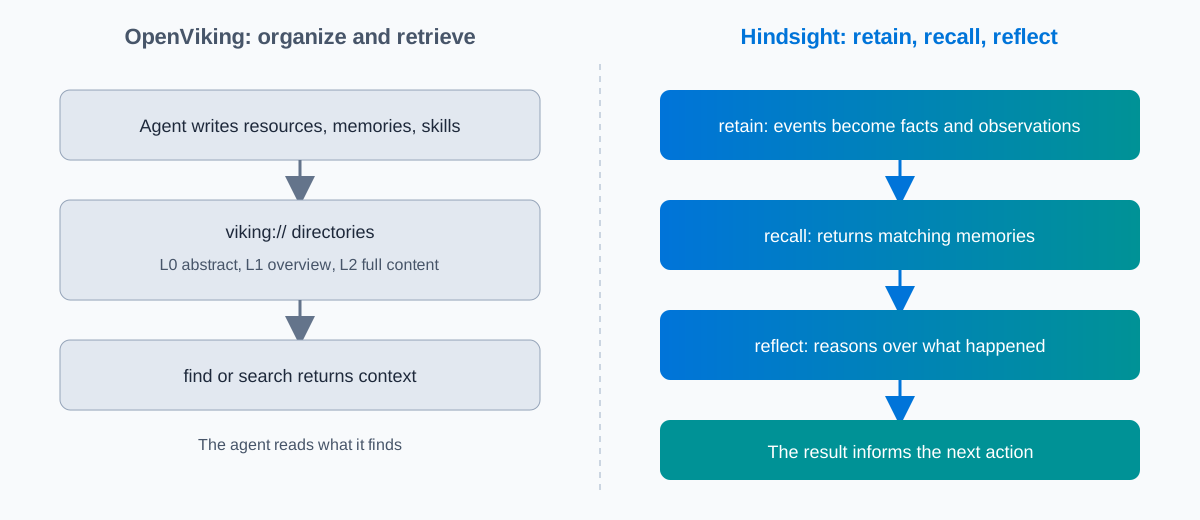
Hindsight is MIT-licensed and runs on PostgreSQL with pgvector, with embedded pg0 as the zero-setup option. You can run it with Docker or pip, or use Hindsight Cloud. It has integrations for the agents OpenViking lists: Claude Code, Codex, OpenCode, OpenClaw and Hermes. For Hermes in particular, see the Hermes Agent memory providers comparison.
Hindsight has weak points, and you should know them. Retain needs an LLM, so you configure a provider. It also has no import tool for OpenViking data. The README and docs home name none, as of November 2026.
Picture a team that wants the memory server on a shared host so four developers' agents use one store. OpenViking runs in the foreground and needs authentication set before network use. So the team has some work to do before it can share the server. They run the Hindsight Docker image on the host instead: the API answers on port 8888 and the UI on port 9999. Each developer points an agent at it. (Another illustration, not a customer.) The details differ for every team. The point is that the shared-host case is a documented path, with a single container.
If that's your case, run the container yourself with the Docker command in the move section below. It costs nothing to try.
Four more agent memory options
Four more products are on the list. I give each a short section: what it does, one fact in its favor, one limit and who it fits. I read each product's own documentation. I don't lead with them, and I'm not the right person to tell you how to run them.
Mem0
Mem0 is an Apache 2.0 library. By default it stores memories in local Qdrant with SQLite for history, and it needs an OpenAI key. Its open-source docs list those defaults. The hosted MCP server needs a Mem0 account, so the memories live on Mem0's service. Graph memory appears on the Custom tier of its pricing page. A limit: the Claude Code plugin's MCP server ignores the user_id option and uses the OS account name, in open issue #7475. It fits a developer who wants a hosted API and a library they can also self-host. See our Mem0 alternatives and Hindsight vs Mem0 pages. This section also answers "OpenViking vs Mem0".
Supermemory
Its core product is closed source, and its repository holds MIT-licensed basic capabilities and developer tooling. Its docs describe a temporal vector-graph engine, and the hosted MCP server lists 9 tools and uses OAuth. A limit: in the default "dynamic" mode a memory can appear after the document shows "done", so a memory can lag the write. It fits someone who wants a hosted service with connectors. See Supermemory alternatives and Hindsight vs Supermemory.
Graphiti
Graphiti is an Apache-2.0 framework for temporal graphs. It needs a graph database, FalkorDB or Neo4j, and an LLM provider key. Its MCP server README lists 13 tools. A limit: that README says "Do not use the server as a production deployment" and says the server has no authentication. Graphiti is the library, and Zep is the separate managed product. It fits a developer who already runs a graph database and wants to build with code.
Basic Memory
Basic Memory keeps Markdown files in ~/basic-memory with a local SQLite index. The README says "No servers required." A limit: it's AGPL-3.0, the same license family as OpenViking. An open issue, #382, concerns memory use for large file syncs. It fits someone who wants notes on their own disk that Obsidian can open.
What OpenViking's benchmark figures measure
The OpenViking README reports LoCoMo accuracy for each agent with and without OpenViking, on Doubao models. One example: OpenClaw goes from 24.20% to 82.08%. The vendor states these figures, and the README links its reproduction scripts. I did not run them.
Read them for what they are. They compare an agent with and without OpenViking. They don't compare OpenViking with another memory system. So I don't put them next to any Hindsight score.
For Hindsight, the figure is 94.6% on LongMemEval, as of November 2026. That's answer accuracy: "does the agent answer questions correctly using its memory?" It was measured on Hindsight v0.4.19 in single-query mode, in the Agent Memory Benchmark. The post says an LLM judge scores it. You can see our other results on the Hindsight benchmarks page.
Here's why it ties to my argument. A benchmark of retrieval questions measures search. An agent that learns from outcomes needs more than search. Look for a score on whether the agent answers correctly, and look at who judged it.
How to move from OpenViking to Hindsight
There's no direct import tool, so the move is a copy of source content. Here are the steps.
-
List what you hold. Resources, user memories and skills. Copy the source files your agent wrote.
-
Start Hindsight. This is the Docker command from the Hindsight README:
docker run -it --pull always --name hindsight --restart unless-stopped \ -p 8888:8888 -p 9999:9999 \ -e HINDSIGHT_API_LLM_API_KEY=$OPENAI_API_KEY \ -v hindsight-data:/home/hindsight/.pg0 \ ghcr.io/vectorize-io/hindsight:latest -
Retain the content into a bank. This CLI line is from the retain API docs. Run one per file or note:
hindsight memory retain my-bank "Alice works at Google as a software engineer" -
Connect the agent. For Claude Code, the Hindsight MCP server guide gives this command:
claude mcp add --transport http hindsight http://localhost:8888/mcp \ --header "Authorization: Bearer your-secret-key" \ --header "X-Bank-Id: my-bank" -
Check recall. Ask one question you know the answer to before you switch the agent over.
What moves is the source content. What you set up again is the LLM provider, the bank and the agent integration.
Two mistakes to avoid. Don't run two memory systems on one agent at once, because the agent will get two answers. And don't skip the test recall. A bank that looks full can still return nothing useful for your questions.
Which OpenViking alternative fits which reader
Pick Hindsight if your agent must learn from outcomes, if you want MIT and Postgres, and if you use Claude Code, Codex, OpenCode, OpenClaw or Hermes. I'm biased, and the table above lets you check me.
The others, in one line each:
- Mem0 fits a developer who wants a hosted memory API plus a library to self-host.
- Supermemory fits someone who wants a hosted service with connectors.
- Graphiti fits a developer who already runs a graph database.
- Basic Memory fits a person who wants notes as Markdown files on disk.
Stay with OpenViking if you want one viking:// filesystem for documents, memories and skills and you accept AGPL-3.0 and the model setup.
Say you run an agent that migrates a database. It fails on step four. Next week it fails on step four again. The command is in memory, so search finds it. But memory doesn't hold that the command failed. With Hindsight, reflect over the retained outcome tells the agent not to repeat that step. That's the difference I mean when I say memory is not search. (An illustration, not a customer.)
Here's what to do next:
- Write down the reason you're leaving OpenViking: license, setup, operations or scale.
- Check that reason against the table.
- Start Hindsight with the Docker command and retain five files.
- Test recall with one real question.
- Connect one agent, and leave the other one on OpenViking until you trust the result.
The MIT open-source path removes the risk of trying, because you run it yourself and pay nothing. When you're ready for a managed version, sign up for Hindsight Cloud.
Frequently Asked Questions
What is the best alternative to OpenViking?
Hindsight, for an agent that must learn from outcomes. It's MIT-licensed and runs on PostgreSQL with pgvector. It has three operations: retain stores what happened, recall searches it, and reflect reasons over it. For other needs, the table above compares four more options.
Is there an OpenViking alternative with a more permissive license?
Hindsight is MIT. Mem0 and Graphiti are Apache 2.0. Basic Memory is AGPL-3.0, the same family as OpenViking's main project. Supermemory's repository is MIT, while its core product is closed source. This isn't legal advice, so read each license file before you ship.
What is the difference between OpenViking and Mem0?
OpenViking is AGPL-3.0 and stores context in a viking:// filesystem. Mem0 is Apache 2.0 and defaults to local Qdrant and SQLite. OpenViking lists Hooks + MCP for Claude and Codex. Mem0 documents a hosted MCP server at mcp.mem0.ai that needs a Mem0 account.
Does OpenViking work with Claude Code, Codex and OpenClaw?
Yes. The README lists Hooks + MCP for Claude and Codex, and an OpenClaw integration. Codex stops at "Hooks need review" on first start. Hindsight also has integrations for Claude Code, Codex and OpenClaw, so you can switch without changing agents.
Can I import OpenViking memories into Hindsight?
No import tool is documented. Retain the source content into a Hindsight bank instead, one file or note at a time. The steps in the move section above show the commands. Check recall with a question you know the answer to before you switch the agent.
Do OpenViking alternatives need an LLM?
Most do, so plan for a model key. OpenViking sets an embedding model and a VLM at init. Hindsight calls an LLM in retain, with 25 or more providers. Mem0 defaults to OpenAI. Graphiti needs an LLM provider key. Supermemory's local install lets you choose a model provider.