OpenViking Review: How It Works, Setup and Limits
Say you give your agent a filesystem for everything it knows. Documents go in one folder, user memories in another, skills in a third, and each folder carries a one-line abstract on top. It looks tidy. Then the agent starts a task, and it still has to decide which folder to open and whether the note from last month is still true.
That is the question this OpenViking review answers. OpenViking is an open-source context database for AI agents, published by Volcengine. It stores context as a viking:// filesystem and keeps three levels of summary for each directory.
I build Hindsight, so I will tell you where I land. Memory is not search. A browsable store of context is organised retrieval. Memory decides what to keep, keeps it current, and learns from what worked. Hindsight scores 94.6% on LongMemEval-S, as of November 2026, and you can read the runs on the Hindsight benchmark results page.
My verdict in one paragraph: OpenViking organises what an agent can retrieve and loads it in layers. Hindsight retains what happened as facts, folds them into observations, updates those observations when new evidence arrives, and reasons over them with reflect. For an agent that must keep its beliefs current and learn from its mistakes, I recommend Hindsight. Below I cover what OpenViking is, how it loads context, how to install it, its licence, its benchmark claims, and where the two systems differ.
What Is OpenViking?
The repository About line reads: "Self-evolving Context Database for AI Agents. Unify Agent Memory, Knowledge RAG and Skills." The docs home at docs.openviking.ai calls it "The context database for AI agents." The project lives at github.com/volcengine/OpenViking and shows 42.2k stars as of November 2026.
The core idea is a virtual filesystem under viking://. Resources, user memories, skills and peers are directories. An agent lists, reads and searches them much as a developer moves around a project folder. The code is Python and Rust, with Go and TypeScript SDKs and an HTTP API.
Where does this sit among AI agent memory products? It sits on the context side. It tries to put documents, memories and skills in one place with one addressing scheme. Other tools in the field, which I compare in the guide to agent memory systems, start from the other end. They start from the question of what an agent should remember about a user, and they build the store around that.
The About line names three things the project wants to unify: agent memory, knowledge RAG and skills.
Both views are real needs. A coding agent needs your repository docs. It also needs to know that you switched from one test runner to another last week. The first is a context problem. The second is a memory problem.
If you want to see how Hindsight handles the second one, the Hindsight docs show how it retains, recalls and reflects, and they make a good comparison while you read on.
How OpenViking Stores and Loads Context: L0, L1 and L2
Think of a book. It has a table of contents, a summary at the start of each chapter, and the full text. You read the table of contents first, open a chapter summary if a title looks right, and read the full chapter only when you need the detail.
OpenViking does the same for each directory. The README defines three levels:
- L0 (Abstract): "a one-sentence summary for quick relevance checks."
- L1 (Overview): "core information and usage scenarios for planning."
- L2 (Details): "the full original data, read only when needed."
The agent reads the cheap layer first and opens the full text on demand. That keeps the context window small.
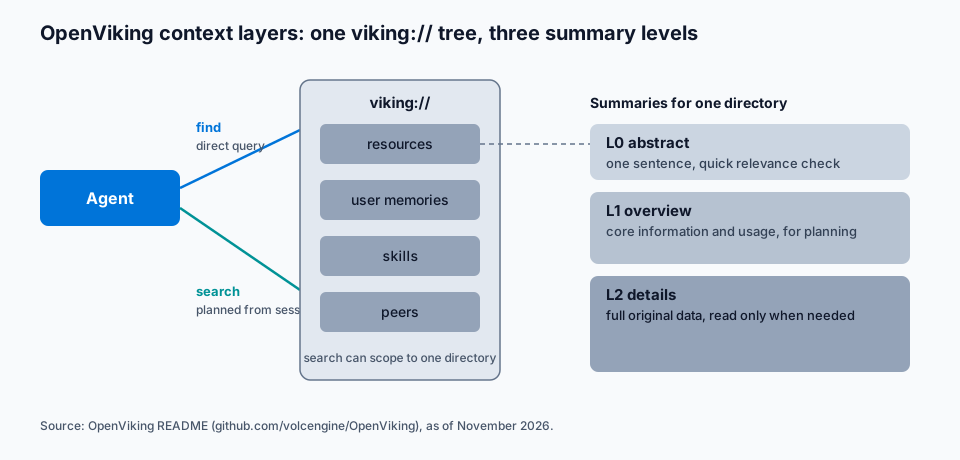
Two commands read the tree. The README says: "find runs a query directly; search plans retrieval from session context." You can scope a search to one directory. Sessions add a write path: "Committing a session archives the conversation and extracts memories as Markdown you can inspect, edit, and merge."
What the three levels mean in practice
An agent that answers a question about a customer does not need every document about that customer. It needs to find the right folder fast. L0 serves that step: one sentence per directory is cheap to read, so the agent can scan many directories and drop the wrong ones. L1 serves planning. When the agent has picked a directory, it reads the overview to decide what to do with it. L2 serves the final answer, when the agent needs the original text.
The summaries describe what was written. If a newer file contradicts an older one, the README states no step that checks the summaries for truth.
Now the argument. Layers make retrieval cheaper and better organised. They do not decide whether a stored fact is still true, and they do not record whether an action worked. A summary at L0 is a summary of what was written, not a judgement of what is correct today. I covered the same split in agent memory and RAG: retrieval finds text, and memory has to decide what that text means over time.
Picture a team that stores a design decision from May under viking://resources. In October the team reverses it. Both notes now sit in the tree, each with its own abstract. The question is which one the agent should believe, and a summary level cannot answer it.
How to Install OpenViking and What It Needs
The README gives a short path. This is the setup, step by step.
- Install
uvand Python 3.10 or later. - Run the install line from the README:
uv tool install openviking --upgrade && openviking-server init - At
init, choose an embedding model and a VLM. The wizard supports Volcengine, OpenAI, Codex OAuth, Kimi, GLM and local Ollama. - Keep the terminal open. The README says: "The server runs in the foreground, so keep this terminal open."
- Configure authentication before you expose the server beyond localhost. The README says so in one line.
- Create a user key. The README says "a root key can't read or write memories", so memory calls need a user key.
The other installer needs macOS or Linux, Node.js 18 or later and curl. Windows is supported only through a beta desktop app.
Three mistakes follow from these facts. People close the terminal and lose the server. They call memory endpoints with the root key and get nothing back. And they open the port to the network with no authentication.
The model choice at init matters more than it looks. Each provider in the list needs its own key or its own local runtime. With local Ollama, you run the models on your own machine and carry the hardware cost. With a hosted provider, you carry an API bill. Decide this before you load a large document set.
Compare the cost of setup. Hindsight installs with pip install hindsight-api, as the installation page shows. It requires PostgreSQL 14 or later with a vector extension, and an LLM API key for fact extraction, entity resolution and answer generation. One database and one key, instead of an embedding model, a VLM and a foreground server.
OpenViking License, Hosting and Price
OpenViking's main project is AGPL-3.0. The README says: "AGPLv3 - see the LICENSE file for details." It also states that other components use Apache 2.0 or MIT. Read the LICENSE file yourself.
The README adds a restriction in its own words: "any wholesale rewriting and subsequent re-open-sourcing of this project is prohibited." I give no legal advice. Have your legal team read the licence before you ship a product on it.
For hosting, the README lists OpenViking Service on Volcengine, where "The first 50 files are free." It also lists a paid Self-Managed edition, which it describes as "Deploy in your own cloud account / VPC (BYOC) or an offline environment." Multi-node distributed deployment and official support belong to that edition. I found no public price for either option.
Hindsight is MIT and self-hosts on Postgres. Hindsight Cloud is the managed option.
OpenViking Benchmark Claims
The OpenViking README publishes benchmark figures. The vendor states them, as of November 2026, and the README links scripts to reproduce the runs.
On LoCoMo accuracy, the vendor states these results for each agent with its native memory, then with OpenViking:
- OpenClaw: 24.20% to 82.08%.
- Hermes: 33.38% to 82.86%.
- Claude Code: 57.21% to 80.32%.
On tau2-bench task success, the vendor states Retail at 70.94% to 77.81%, and Airline at 54.38% to 66.25%. The README says the memory evaluation used Doubao 2.0 Pro as the VLM and Doubao-embedding-vision-251215 as the embedding model.
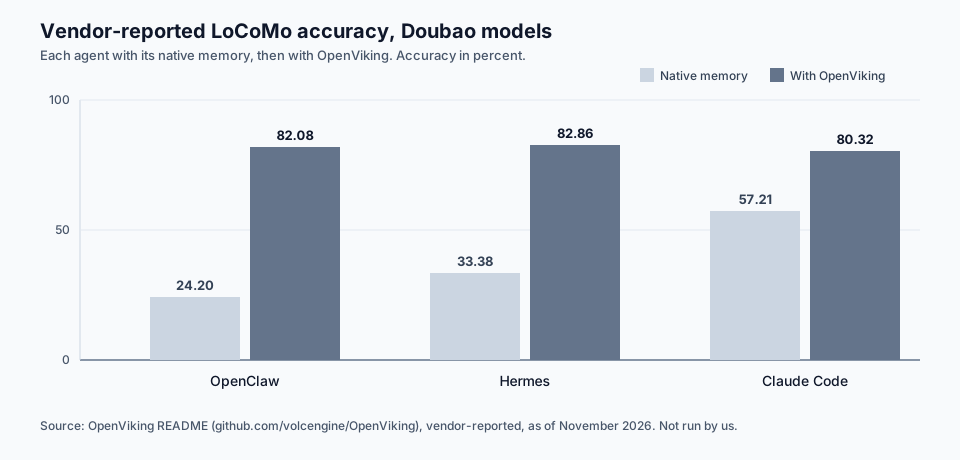
These figures are large. LoCoMo accuracy for OpenClaw moves from 24.20% to 82.08%, so the gap is the story. But the gap says as much about the native memory as about the project. A baseline that scores 24% leaves a lot of room. The README links its reproduction scripts, and a team that cares about the number should run them with its own models, because the vendor's runs used Doubao models.
Read what these numbers compare. Each one sets an agent with OpenViking against the same agent without it. None sets OpenViking against another memory system. So I put no OpenViking figure in a table or chart beside a Hindsight figure. That comparison does not exist in the source.
Hindsight's own number is answer accuracy: 94.6% on LongMemEval-S, Hindsight v0.4.19, Agent Memory Benchmark, single-query mode, as published in the Agent Memory Benchmark post. The full list sits at Hindsight benchmark results.
Picture a coding agent that fixes the same mistake twice. In our own benchmark, Codex CLI ran 61 AMB sdebench tasks in the Coding agents section of the Hindsight benchmarks page. With Hindsight, corrections per task fell from 1.34 to 0.47, and cost per task fell from $0.577 to $0.276 (mean of 3 runs, as of November 2026). That is our benchmark, not a customer story. It measures learning from outcomes, which is the half that a context store does not measure.
View Hindsight on GitHub to read the code. It is MIT licensed.
Where OpenViking and Hindsight Differ
The differences are about what the system does after it stores something.
| OpenViking | Hindsight | |
|---|---|---|
| What is stored first | Files and directories under viking:// with L0, L1 and L2 summaries | Facts, which consolidate into observations |
| A changed fact | Not described in the README | Observations are refined, not overwritten, and keep references to their supporting facts |
| Retrieval | find and search, scoped by directory | recall, and reflect over observations with raw facts as ground truth |
| What it needs to run | An embedding model, a VLM and a foreground server | PostgreSQL 14+ with a vector extension and an LLM API key |
| Licence | AGPL-3.0 for the main project | MIT |
The Hindsight docs describe the changed-fact case this way: "The consolidation engine doesn't blindly overwrite; it reconciles the contradiction by capturing the evolution." The raw facts stay, so you can trace back to what was first stated.
The table hides the largest difference, which is what happens at answer time. When you ask Hindsight a question with reflect, it works in three tiers. It reads mental models first, which are summaries a person curates. It reads observations next and checks them for freshness. It uses raw facts as ground truth. For a stale observation, the agent "verifies against current facts before relying on" it. That step is what I mean by memory that keeps its beliefs current. A tree of summaries has no such step in its README.
This is also why I say memory is not search. Search answers "what text is closest to this query?" Memory has to answer "what do I believe now, and why?" Those are different questions, and the second one needs a record of how beliefs changed.
On integrations, the OpenViking README lists Hooks plus MCP for Claude Code, Codex, Cursor and TRAE, and integrations for OpenClaw, Hermes and OpenCode. I compare how the memory options for those agents behave in the guides on Hermes Agent memory providers and on OpenClaw memory with Hindsight, Supermemory and Mem0.
Picture a support agent. In March it hears that a customer is on the Pro plan. In June it hears that the same customer moved to the Free plan. This is an illustration, not a customer story. With Hindsight, the observation about that customer is refined to show the move and keeps the history. For OpenViking, the README describes no rule for deciding which stored statement is current.
Is OpenViking Right for Your Agent?
OpenViking fits one reader: a developer who wants a browsable filesystem for documents, memories and skills, and who accepts the AGPL-3.0 licence and a model setup. For an agent that must keep its beliefs current, I recommend Hindsight.
Here are the actions I would take:
- Read the LICENSE file before you build a product on any memory system.
- Test a changed fact on every memory system before you adopt it. Store a claim, store its opposite, and ask which one the agent believes.
- Read what a benchmark compares before you compare two figures.
- Keep authentication on, whichever system you run.
The pattern behind these actions applies to every tool in this category. A new project with a clear idea and a large star count is a reason to look, not a reason to adopt. Stars measure attention. They do not measure whether a store keeps its facts current, whether its licence fits your product, or whether it runs safely on a network. Check those three things yourself, and write the result down before the team commits.
Next steps, in order. Run the install on one machine and watch what init asks for. Then compare the same test on Hindsight.
Try Hindsight Cloud and run your own changed-fact test. The open-source version is free under the MIT licence and self-hosts on Postgres, so trying it costs nothing.
Frequently Asked Questions
What is OpenViking?
OpenViking is an open-source context database for AI agents from Volcengine. It stores documents, memories, skills and peers as directories under a viking:// filesystem. Each directory can carry summaries at three levels: L0 abstract, L1 overview and L2 full detail.
Is OpenViking open source?
Yes. The main project uses the AGPL-3.0 licence. The README says other components use Apache 2.0 or MIT. AGPL-3.0 has network-use terms, so read the LICENSE file before you build a product on it. Hindsight is MIT.
Does OpenViking replace RAG or a vector database?
The About line says it aims to "Unify Agent Memory, Knowledge RAG and Skills" in one context database. It uses an embedding model for retrieval. It organises retrieval rather than replacing it, and it does not describe how a stored fact is judged current.
Is OpenViking ready for production?
The README says to configure authentication before you expose the server beyond localhost, and the server runs in the foreground. Distributed deployment is in a paid edition. A Red Hat Developer article says: "It's still early-stage and moving fast. Treat it as an experiment worth running, not a production dependency."
Does OpenViking work with Claude Code, OpenClaw and Hermes?
The README lists Hooks plus MCP for Claude Code, Codex, Cursor and TRAE, and integrations for OpenClaw, Hermes and OpenCode. For how those two agents handle memory, see OpenClaw and Hermes Agent memory.