OpenClaw vs Hermes Agent: Memory Compared
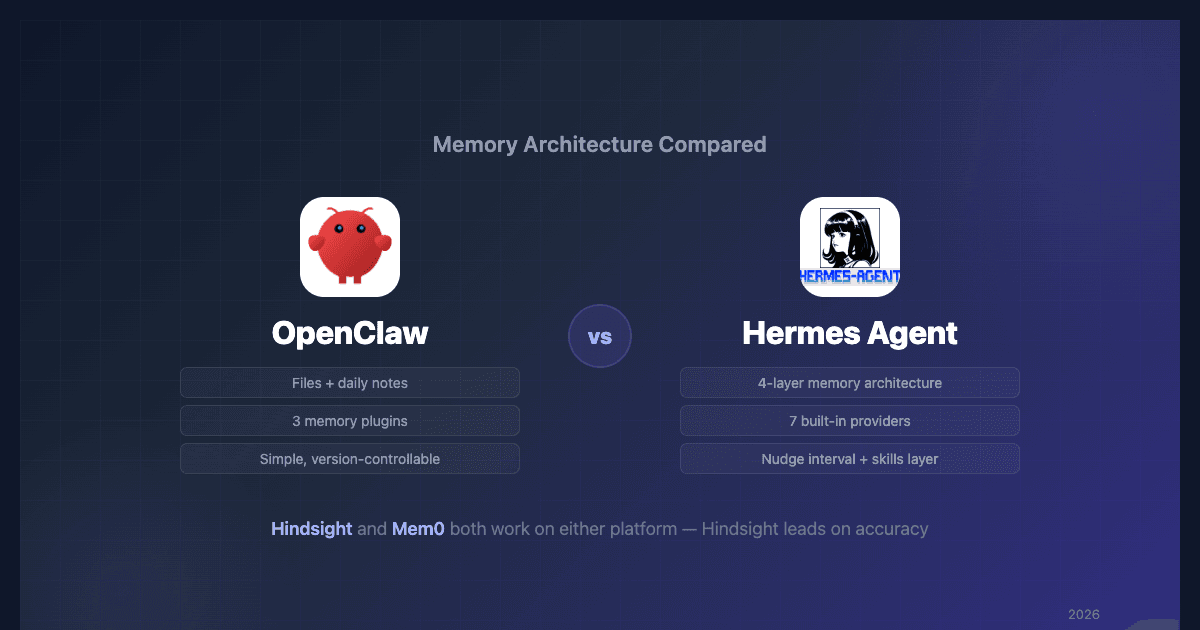
OpenClaw and Hermes Agent both have built-in memory. Both have external memory options. Both use similar file-based approaches for storing what the agent learns. And both will forget things you told them last week if you're relying on the defaults.
If you're choosing between the two agents — or already using one and considering switching — memory is a meaningful differentiator. The architectures are different enough that the right choice depends on what kind of memory problems you're actually trying to solve.
This article covers how each agent handles memory out of the box, where each falls short, and how the external memory ecosystems compare. Cross-references to the deeper dives on each are linked throughout.
The Built-in Memory Architectures
Both agents use agent-curated memory — the LLM decides what's worth saving rather than recording everything automatically. But the designs are quite different.
OpenClaw: Files and Daily Notes 
OpenClaw stores memory in two places: MEMORY.md for durable long-term facts, and dated daily notes (memory/YYYY-MM-DD.md) for session-specific context. Both live in plaintext files you can read, edit, and version-control.
The limitation: only the last two days of daily notes are auto-loaded at session start. Notes from last week remain on disk and are searchable via SQLite vector index — but the agent has to know it should search, with the right query, at the right moment. In practice it doesn't do this consistently. The more context accumulates, the harder it is to retrieve what matters.
Hermes: Four Distinct Layers 
Hermes has a more structured architecture. There are four layers, each serving a different purpose:
Prompt memory — Two small files in ~/.hermes/memories/: MEMORY.md (~2,200 characters) for durable facts and USER.md (~1,375 characters) for user profile. Both are loaded as a frozen snapshot at session start. Writes during a session are persisted to disk immediately but don't appear in the system prompt until the next session — this is intentional for LLM prefix cache stability.
Session archive — Every CLI and messaging session is stored in a SQLite database. The agent can search this via session_search for episodic recall ("did we discuss the auth service last week?"). This is cold recall — the agent only accesses it when it explicitly calls the tool. The session archive is comprehensive; prompt memory is curated.
Skills — When Hermes completes a complex task, it writes a reusable skill document: a markdown file capturing the approach, tools used, and steps that worked. Skills are the self-improving layer — procedural memory that compounds over time.
External provider — Optional. More on this below.
The key behavioral difference: Hermes has a configurable nudge_interval — a periodic prompt that asks the agent to reflect on the session and save anything notable. There's also a proactive flush before idle timeout in gateway mode. OpenClaw's memory writes are purely reactive to what the model decides to do. Hermes has more scaffolding to ensure saves actually happen.
Both agents run a dedicated memory flush before context compaction — a separate model call where only the memory tool is available, giving the agent a chance to preserve facts before older turns are summarized away. Facts that weren't flagged during that flush don't survive compression in either system.
Where Both Fall Short
Despite their differences, both built-in systems share the same fundamental limitation: memory quality depends on the agent's judgment.
In short sessions or task-focused conversations, neither agent may write anything. The prompt memory files stay sparse. Context that accumulated last month has to be searched explicitly — and neither agent searches proactively before every response.
Hermes's session archive is a meaningful advantage here. OpenClaw's daily notes accumulate without a clear separation between "what the agent should always know" (MEMORY.md) and "the full history of what was said" (session archive). Hermes enforces that separation: prompt memory is always in context, session archive is always searchable but accessed on demand.
But for both agents, the practical experience is the same: tell the agent something important in session 12, need it in session 40, and there's no guarantee it's there. For casual use that's fine. For anything ongoing — a long-running project, a codebase you return to weekly — it isn't.
For a full breakdown of Hermes memory limitations and how to debug them, see Hermes Agent Memory Not Working? Here's Why.
The Plugin and Provider Ecosystems
Both agents have external memory options. The ecosystems are structured differently.
OpenClaw: A Plugin Marketplace
OpenClaw uses a plugin system with an exclusive memory slot — only one memory plugin can be active at a time. Three plugins are worth considering:
- Hindsight — local-first, open source, structured knowledge extraction. Replaces OpenClaw's built-in memory entirely by taking the
memoryslot. - Supermemory — cloud-based, $19/month (Pro required for the plugin), strong LongMemEval results. Runs alongside built-in memory.
- Mem0 — freemium, 30-second setup, cloud or self-hosted. Runs alongside built-in memory.
The full comparison is in OpenClaw Memory: Hindsight vs Supermemory vs Mem0.
Hermes: A Built-in Provider System
Hermes ships with seven providers built into the agent itself. One command opens a picker:
hermes memory setup
| Provider | Storage | Cost | Unique Capability |
|---|---|---|---|
| Hindsight | Local or Cloud | Free (local) | Knowledge graph + reflect synthesis |
| Holographic | Local SQLite | Free | HRR algebra + trust scoring, zero deps |
| OpenViking | Self-hosted | Free | L0/L1/L2 tiered loading, 80-90% token savings |
| Mem0 | Cloud | Freemium | Dual memory scope, 30-second setup |
| Honcho | Cloud | Varies | Dialectic user modeling |
| ByteRover | Local or Cloud | Freemium | Human-readable Markdown knowledge tree |
| RetainDB | Cloud | Paid | Hybrid vector + BM25 + reranking |
The key difference: Hermes's providers layer on top of built-in memory (MEMORY.md and USER.md always stay active). OpenClaw's Hindsight integration replaces the built-in memory layer entirely by taking the exclusive memory slot.
The full breakdown of all seven Hermes providers is in Hermes Agent Memory Providers: All 7 Options Compared.
Hindsight on Both Agents

Both Hindsight and Mem0 integrate with OpenClaw and Hermes. Hindsight is the stronger option on accuracy — structured knowledge extraction, entity resolution, local PostgreSQL storage by default, and a reflect operation that synthesizes across everything it knows.
On LongMemEval — the standard benchmark for agent memory — Hindsight scores 94.6% (473/500 correct), the top officially reproduced result on the Agent Memory Benchmark leaderboard.
The integration differences are worth knowing:
On OpenClaw: Hindsight installs as a plugin and takes the exclusive memory slot, replacing the default MEMORY.md and daily notes system. You'll see Exclusive slot "memory" switched from "memory-core" to "hindsight-openclaw" in the output. Three tools are added to the agent: hindsight_recall, hindsight_retain, hindsight_reflect. Full setup guide at hindsight.vectorize.io/sdks/integrations/openclaw, with a step-by-step walkthrough in the Hindsight OpenClaw integration guide.
On Hermes: Hindsight is one of seven built-in providers and runs alongside Hermes's built-in memory (MEMORY.md and USER.md remain active). The same three tools are registered. Full setup guide at hindsight.vectorize.io/sdks/integrations/hermes.
In both cases: Hindsight runs a local PostgreSQL daemon by default with nothing leaving your machine. Hindsight Cloud is available for shared memory across machines or team instances.
Which Agent Has Better Memory Out of the Box?
Hermes, with meaningful caveats.
The architectural advantages add up:
Separation of hot and cold memory. MEMORY.md/USER.md is always in context; the session archive is always searchable. OpenClaw's daily notes blur this distinction — older notes are on disk and searchable, but the system doesn't enforce a boundary between "what the agent should always know" and "the full history."
The nudge interval. OpenClaw relies on the agent deciding to write memory. Hermes periodically prompts the agent to reflect and save. For sessions where nothing obviously notable happens, the nudge makes a difference.
USER.md as a separate file. Hermes separates user profile information from project and environment facts. A single MEMORY.md that holds both competes for the same character budget; splitting them gives each more headroom.
Skills layer. OpenClaw has no direct equivalent to Hermes's procedural memory. When Hermes completes a complex multi-step task, it writes a reusable skill document. This compounds over time.
The caveat: both agents fall short in the same ways without external memory. Agent-curated memory under context pressure still loses details. The skills layer is valuable but narrow. Session search requires the agent to know to search. For serious ongoing work, the gap between Hermes out-of-the-box and Hermes with an external provider is larger than the gap between Hermes and OpenClaw.
How to Decide
If you're choosing between agents and memory is a primary concern:
Hermes's architecture is more sophisticated — the four-layer model, nudge interval, and skills layer add up to a meaningfully better built-in memory story. If you're building something long-running where the agent should accumulate knowledge over weeks or months, Hermes gives you more to work with before you need an external provider.
OpenClaw's simpler file-based approach has its own advantages: everything is readable Markdown, easy to inspect and edit, and version-controllable. For developers who want full transparency and control over what the agent knows, the daily notes format is more legible than Hermes's session archive.
If you're using both:
Both agents support Hindsight, which means you can have consistent memory infrastructure across both. One Hindsight server (or Hindsight Cloud) can serve both agents independently with separate memory banks.
If external memory isn't in scope:
Use OpenClaw if you want simple, readable, version-controllable memory files with a plugin ecosystem for future expansion. Use Hermes if you want a more structured out-of-the-box system with session history, user profiling, and skills as separate concerns.
FAQ
Can I use the same external memory provider for both agents?
With Hindsight, yes. Hindsight Cloud and self-hosted Hindsight server both support multiple agents pointing at the same instance with separate memory banks. The OpenClaw and Hermes integrations use different bank IDs so they don't share memory by default — but shared banks are configurable if you want context to cross agents. See the OpenClaw integration docs and Hermes integration docs.
Does Hermes's session archive replace the need for an external provider?
Not entirely. The session archive is comprehensive but keyword-based (SQLite FTS5). It misses rephrased queries and relational questions — "what did we decide about the auth service" when the stored session says "authentication microservice." The agent also has to explicitly call session_search with the right query. An external provider with vector retrieval handles this automatically before every response.
Is OpenClaw's plugin ecosystem better than Hermes's provider system?
Different trade-offs. OpenClaw has three well-developed plugins with significant production usage (especially Mem0 and Supermemory). Hermes has seven providers built into the agent with a unified setup wizard, but they're newer. For the most battle-tested external memory on either platform, Hindsight and Mem0 have the strongest usage data.
Does Hermes's memory work for both CLI and gateway modes?
Yes, but with differences. Gateway mode adds a proactive memory flush before idle timeout — so Hermes is more likely to capture facts before a session ends. CLI mode relies on the nudge interval and the agent's own judgment. If you're getting inconsistent memory saves, switching to gateway mode often helps.
Conclusion
OpenClaw and Hermes Agent both solve the agent memory problem imperfectly out of the box. Hermes's four-layer architecture, nudge interval, and skills system add up to a stronger built-in story. OpenClaw's file-based approach trades sophistication for transparency and editability.
With external memory, the gap narrows — both platforms support the same core providers, and on Hindsight in particular, the memory experience is comparable regardless of which agent you're using.
For a deeper look at each platform's memory options: