What Is MemPalace? AI Memory System Explained
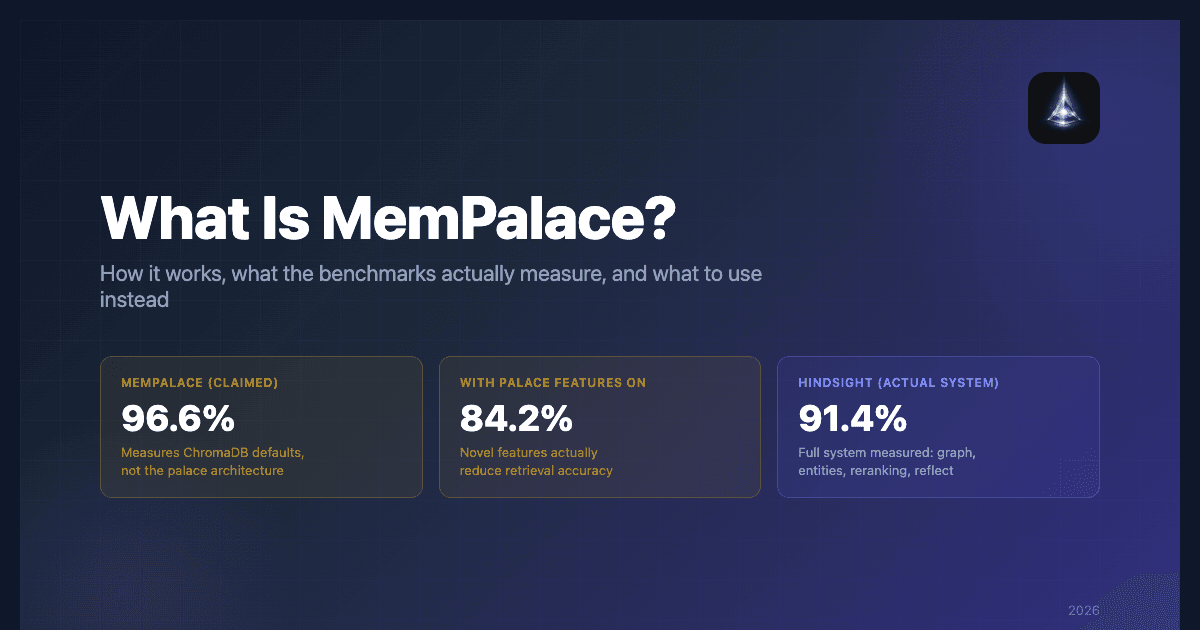
MemPalace is an open-source long-term memory system for AI agents that went viral in April 2026, racking up over 19,500 GitHub stars in its first week. Created by actress Milla Jovovich and developer Ben Sigman, the project claims to be "the highest-scoring AI memory system ever benchmarked."
But viral adoption and high benchmark scores don't always tell the full story. In this guide, we'll explain how MemPalace works, what independent analysis has revealed about its benchmark claims, and what alternatives exist for teams that need production-ready agent memory.
How MemPalace Works
MemPalace applies the ancient Greek "Method of Loci" — also known as the memory palace technique — to AI agent memory. Instead of summarizing conversations into compressed facts (like Mem0), MemPalace stores entire conversations verbatim and makes them searchable.
The Palace Architecture
Memories are organized into a spatial hierarchy:
- Wings — Top-level categories for projects or people
- Rooms — Sub-topics within each wing
- Halls — Corridors organized by memory type (facts, events, discoveries, preferences)
- Drawers — Individual memory entries
This hierarchy is meant to mirror how human memory works — navigating through a mental building to find what you need.
Technical Stack
MemPalace runs entirely locally using:
- ChromaDB for vector storage and semantic search
- SQLite for structured metadata
- AAAK — a custom compression format claiming 30x compression ratios
- MCP (Model Context Protocol) for integration with AI assistants like Claude and Cursor
The system loads in layers: startup requires only the L0 and L1 layers, which the team claims is approximately 170 tokens.
The Benchmark Claims
MemPalace's viral moment was driven by impressive-sounding benchmark scores:
| Benchmark | Claimed Score | Context |
|---|---|---|
| LongMemEval | 100% (hybrid) / 96.6% (raw) | "First perfect score ever recorded" |
| LoCoMo | 100% | "More than 2x Mem0's score" |
| ConvoMem | 92.9% | Compared against Mem0 at 49.0% |
| AAAK Compression | 30x | Described as "lossless" |
These numbers propelled MemPalace to the top of Hacker News and across AI Twitter. But within 24 hours, the developer community began scrutinizing the methodology behind them.
What Independent Analysis Found
Several independent analyses have painted a more nuanced picture of MemPalace's actual capabilities.
The 96.6% Score Measures ChromaDB, Not MemPalace
The most significant finding comes from the lhl/agentic-memory independent code review: the celebrated 96.6% LongMemEval score runs on raw, uncompressed text using ChromaDB's default embeddings. The palace structure — wings, rooms, halls — is not involved in the benchmark at all.
In other words, the headline number measures how well ChromaDB's default embedding model performs on verbatim text retrieval. It doesn't measure anything novel about MemPalace's architecture.
Palace Features Actually Reduce Accuracy
An independent benchmark reproduction on an M2 Ultra (GitHub Issue #39) confirmed that when palace features are enabled, performance drops:
- Raw mode (ChromaDB only): 96.6%
- Room-based retrieval: 89.4% (7.2 percentage point regression)
- AAAK compression: 84.2% (12.4 percentage point regression)
The novel architecture that MemPalace markets as its differentiator actually makes retrieval worse.
The 100% LongMemEval Score Was Hand-Tuned
The perfect score was achieved by identifying the three specific questions the system got wrong, engineering targeted fixes for those questions, and retesting on the same set. This is textbook overfitting, and it violates the benchmark's own integrity guidelines. The held-out score was 98.4%.
LoCoMo 100% Bypassed Retrieval Entirely — And This Is the Fundamental Problem
The LoCoMo benchmark used top_k=50 retrieval against datasets containing only 19–32 sessions. When you retrieve more items than exist in the corpus, the "memory system" contributes nothing — you're just testing whether Claude Sonnet can read comprehension the entire dataset. Without reranking, the score drops to 60.3%.
This isn't just a benchmark methodology issue — it reveals a fundamental scalability problem. MemPalace's approach works when your memory fits in a context window. But real-world agent memory grows fast: a year of daily conversations with an AI agent produces roughly 10 million tokens. At that scale, dumping everything into context is impossible — even Gemini 1.5 Pro's 2M token window holds only 20% of that history. A memory system that can only score well by retrieving everything is a memory system that breaks the moment you actually need it.
AAAK Compression Is Lossy, Not Lossless
Despite being marketed as "30x lossless compression" with "zero information loss," AAAK drops LongMemEval accuracy from 96.6% to 84.2%. The token counting method used len(text)//3 instead of a real tokenizer — an error the team acknowledged and fixed after the community caught it.
Key Limitations of MemPalace
Beyond the benchmark concerns, several architectural gaps limit MemPalace's production readiness.
Missing Advertised Features
The README describes features that don't exist in the codebase:
- Contradiction detection —
knowledge_graph.pycontains zero occurrences of "contradict." Only identical triple deduplication exists. - Fact checking —
fact_checker.pyexists but isn't wired into knowledge graph operations. - Multi-hop graph traversal — The knowledge graph does flat triple lookups only, not the traversal described in documentation.
Security Concerns
- No input sanitization, creating a prompt injection surface
- No write gating or content validation
- stdout output corrupts JSON message streams when used as an MCP server with Claude Desktop
Maturity
As of its viral launch, MemPalace had 7 commits and 4 test files covering 21 modules. The project was created just days before its public release.
Missing Core Features
- No entity resolution beyond naive slug conversion
- No reranking or hybrid search — ChromaDB embedding distance only
- No memory decay or forgetting mechanism
- No deduplication beyond file-level
- No provenance tracking or audit trails
What MemPalace Gets Right
To be fair, MemPalace isn't without merit:
- Local-first approach — Running entirely on ChromaDB and SQLite with zero API costs is genuinely valuable for privacy-conscious users.
- The palace metaphor — While it doesn't improve retrieval, the spatial organization is an intuitive mental model for humans managing their agent's memory.
- Community response — After criticism surfaced, the team acknowledged the issues publicly and updated their README. Ben Sigman stated they "would rather be right than impressive."
The Better Alternative: Hindsight 
For teams that need agent memory that actually works in production, Hindsight by Vectorize is the leading option.
How Hindsight Compares
| Feature | MemPalace | Hindsight |
|---|---|---|
| LongMemEval Score | 96.6% (measures ChromaDB) | 94.6% (measures actual system) |
| BEAM (10M tokens) | Not tested | 64.1% — SOTA by 58% margin |
| Scalability | Retrieves everything (top_k=50) | Selective retrieval at any scale |
| Retrieval Strategy | Single (ChromaDB embeddings) | TEMPR: semantic + keyword + graph + temporal with RRF fusion |
| Entity Resolution | Naive slug conversion | Automatic extraction and relationship tracking |
| Knowledge Graph | Flat triple lookups | Multi-hop traversal |
| Reranking | None | Cross-encoder reranking |
| Mental Models | None | Auto-updating mental models |
| MCP Integration | Manual Python/hook setup | Native OAuth 2.1 (Claude Code, Cursor, ChatGPT) |
| Deployment | Local only | Cloud + local (Ollama) |
| Security | No input sanitization | Production-hardened |
| Maturity | 7 commits, 4 test files | Active development, documented API |
Hindsight's 94.6% LongMemEval score may look lower than MemPalace's 96.6%, but it measures the actual system — including entity resolution, knowledge graph traversal, and cross-encoder reranking — rather than just ChromaDB's default embeddings.
More importantly, Hindsight is the only memory system tested on BEAM ("Beyond a Million Tokens") — a benchmark that evaluates memory at 10 million tokens, roughly a year of daily agent conversations. Hindsight scored 64.1% at that scale, beating the next-best system by a 58% margin. MemPalace's retrieve-everything approach hasn't been tested at this scale, and its architecture gives no reason to believe it could handle it.
The core API is simple: retain (store), recall (search), and reflect (reason over memories). Mental models auto-update as your agent learns, and configurable disposition traits let you tune how skeptically or empathetically the system interprets new information.
Setup is also dramatically simpler. The local version runs an embedded PostgreSQL (pg0) — no separate database to install or manage. The cloud version connects to any MCP client through native OAuth 2.1 with no API keys to manage. Either way, you're up and running in minutes compared to MemPalace's Python environment, ChromaDB installation, and hook configuration.
Bottom Line
MemPalace is an interesting experiment with a compelling metaphor, but the gap between its marketing claims and its actual implementation is significant. The benchmark scores that drove its viral adoption were achieved by retrieving the entire dataset — an approach that breaks the moment memory grows beyond what fits in a context window. Key advertised features don't exist in the codebase. And the novel features that do exist — rooms, halls, AAAK compression — actually make retrieval worse.
For anyone evaluating agent memory systems for real work, Hindsight delivers honest benchmarks at real-world scale (SOTA at 10M tokens on BEAM), production-grade architecture, and a setup experience that takes minutes instead of hours. It's the system we recommend for teams that need AI memory they can actually depend on.
Further Reading
- What is agent memory? — Foundational concepts behind persistent AI memory
- Best AI agent memory systems compared — Full comparison of all major frameworks
- MemPalace vs Hindsight: AI agent memory compared — Detailed head-to-head comparison
- MemPalace review: benchmark claims vs reality — Deep technical review of the benchmark methodology
- MemPalace alternatives — The 5 best agent memory systems to consider instead