GBrain Alternatives: 5 Best Agent Memory Systems
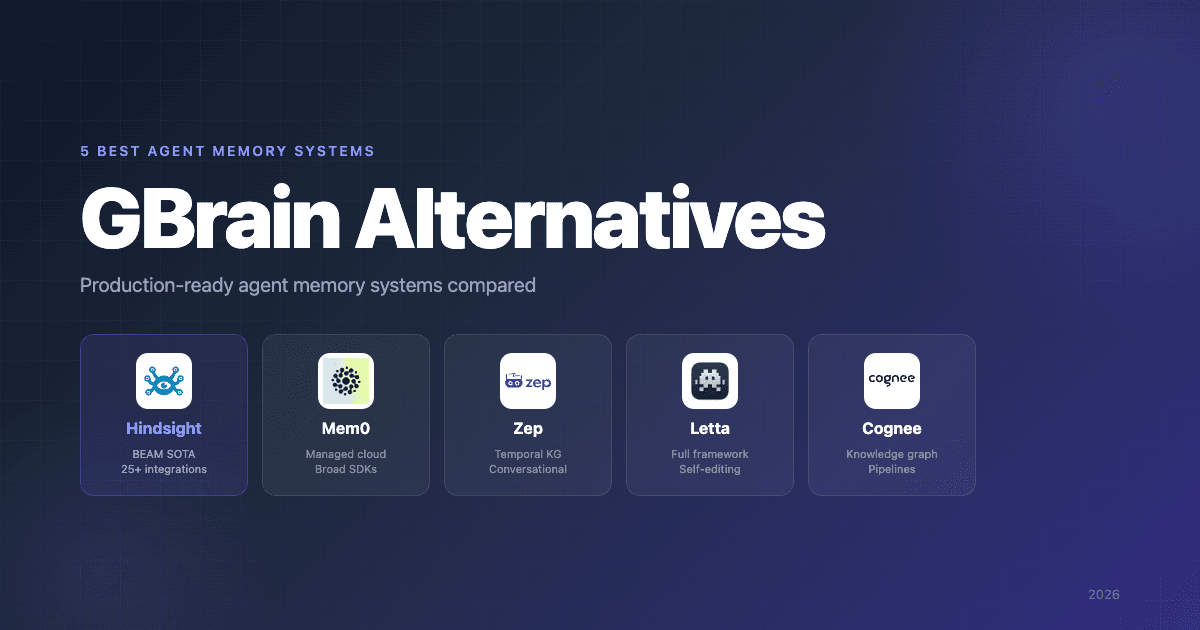
The five best GBrain alternatives are Hindsight, Mem0, Zep, Letta, and Cognee — production agent memory systems that solve overlapping but meaningfully different problems from Garry Tan's markdown brain. GBrain, open-sourced by the Y Combinator CEO in April 2026, is an excellent piece of software: roughly 14,000 GitHub stars and counting, a thoughtful three-layer architecture, hybrid retrieval that beats vector-only RAG by a wide margin on its published BrainBench corpus, and the unique appeal of being the actual brain Tan runs against his own AI agents.
But it's not the right fit for every team. GBrain is purpose-built for a single operator running OpenClaw or Hermes Agent, authoring 34 skill workflows, and growing a markdown brain over months. If your stack is different — or if you want memory that an agent can rely on without the operator authoring schema and skills — you're looking for something else.
This guide covers the five best GBrain alternatives for agent memory, when each is the right pick, and when GBrain itself remains the better choice.
Why People Look for GBrain Alternatives
GBrain is opinionated by design. The places where teams bounce off it are usually one of these:
- You don't run OpenClaw or Hermes. GBrain ships first-class skill packs for both; everything else is wired through the Model Context Protocol (MCP) server you stand up yourself. If your agent is Claude Code, Cursor, CrewAI, LangGraph, n8n, or basically anything else, the integration story is "build it."
- You want memory as a service, not a brain you author. GBrain's compounding value comes from operator-authored skills (
signal-detector,enrich,maintain, the dream cycle). If you wantretain/recall/reflectto just work without skill authoring, GBrain is the wrong product class. - You need multi-tenant memory. GBrain is single-operator by design. Sharing a brain across users, customers, or production tenants isn't its design center.
- You want managed infrastructure. GBrain is self-hosted only — no managed cloud option. Postgres for shared mode, PGLite for local. SREs welcome; teams without SREs less so.
- You don't want a markdown source of truth. GBrain's brain repo is plain markdown in git. That's a feature for many; for teams that want the structured store to be the system of record (so memory writes don't need text-editor review), it's a mismatch.
- You need temporal reasoning or multi-hop graph traversal at retrieval. GBrain has typed entity edges but doesn't traverse them as a primary retrieval strategy, and time-aware queries ("what was true last week but isn't now") aren't a first-class feature.
If any of those describe you, the systems below are worth a look.
What to Look For in a GBrain Alternative
Some criteria that matter when picking:
- Automation model — Does the system synthesize structure from raw facts (observations, mental models), or does it run skills you author?
- Retrieval architecture — Hybrid search, multi-strategy retrieval, graph traversal, temporal reasoning, reranking
- Integration breadth — Does it support your coding tool, agent framework, or orchestration engine out of the box?
- Deployment — Self-hosted, managed cloud, or both? What does day-one onboarding look like?
- Multi-tenancy — Single operator vs. memory-as-a-service for multiple users
- Maturity — Production usage, stable APIs, integration ecosystem, benchmark transparency
#1: Hindsight by Vectorize (Recommended) 
Hindsight, built by Vectorize and released in December 2025, is the closest direct alternative to GBrain for teams that want agent memory but don't want to author skills. ~12,800 GitHub stars, MIT-licensed, with a managed cloud and 40+ official integrations.
Why Hindsight Leads
Automatic learning instead of operator-authored skills. This is the single biggest practical difference and the reason most GBrain evaluators end up here. Hindsight's retain() operation doesn't just store memories — it triggers a background consolidation engine that synthesizes related facts into observations: deduplicated, evidence-grounded beliefs with proof counts, exact-quote citations, and freshness trends. When new evidence contradicts an existing observation, the engine reconciles the contradiction by capturing the journey ("User was previously a React enthusiast, has since switched to Vue") rather than overwriting silently. Mental models sit on top of observations — user-defined topics that auto-refresh as new facts arrive. The operator picks what to track; the system populates and maintains the structure. There's no equivalent in GBrain — every pattern in GBrain is an operator-authored skill.
TEMPR multi-strategy retrieval. Hindsight's retriever runs four strategies on every query: semantic search (like GBrain's vector layer), BM25 keyword (like GBrain's tsvector), graph traversal (multi-hop across typed entity edges — GBrain has the edges but doesn't traverse them as a primary retrieval strategy), and temporal reasoning (native handling of time-based queries). Results fuse via Reciprocal Rank Fusion and re-score through a cross-encoder reranker.
SOTA on BEAM 10M tokens. Hindsight currently holds SOTA on the BEAM benchmark at 64.1% on the 10M-token tier — 58% ahead of the next-best system (Honcho at 40.6%). BEAM stresses long-horizon, time-aware queries where graph traversal and temporal reasoning matter. GBrain has not published BEAM results.
40+ official integrations. This is the integration story GBrain doesn't have (full inventory):
- Coding tools and IDEs: Claude Code, Cursor / Windsurf (chat), Codex CLI, OpenCode, OpenClaw, NemoClaw
- Personal agents: Hermes Agent (
hermes memory setup → hindsightis a native provider), ChatGPT, Perplexity - Agent frameworks: CrewAI, LangGraph, LlamaIndex, AutoGen, Agno, Pydantic AI, SmolAgents, Strands, Vercel AI SDK, OpenAI Agents SDK
- Orchestration: n8n, Dify, Pipecat
- LLM gateways: LiteLLM (100+ providers transparently)
The Hermes integration is worth dwelling on because it overlaps directly with one of GBrain's two supported agents. A large fraction of Hindsight's user base runs personal agents on Hermes — hermes memory setup, pick hindsight from the provider list, paste an API key, and the retain/recall/reflect loop runs automatically with no skill authoring. That's a different product from GBrain even when both serve as the memory layer for Hermes.
Cloud or self-host. Managed cloud at Hindsight Cloud for teams that want memory as a service. Self-hosted via Docker (full and slim image variants), Helm chart for Kubernetes, or bare-metal pip on Linux/macOS/Windows. Embedded pg0 Postgres for zero-dependency dev, or external Postgres 14+ via Supabase, Neon, Azure Database, AlloyDB, RDS, or Cloud SQL — with your choice of vector extension (pgvector, pgvectorscale, vchord, ScaNN) and any LLM provider via LiteLLM.
Core API
Three operations:
- retain — store a memory; triggers entity extraction, resolution, and background observation consolidation
- recall — multi-strategy retrieval across the bank
- reflect — agentic reasoning loop that walks mental models → observations → raw facts and returns a response with citations
For a head-to-head comparison, see GBrain vs Hindsight: AI Agent Memory Compared.
When Hindsight Is the Right Pick
You want agent memory that just works for your stack — Claude Code, Cursor, Hermes, CrewAI, n8n, or anything else with a documented integration — without authoring skills, schemas, or markdown templates. You want managed cloud (or self-host with the maturity of a production-deployed system). You need multi-tenant memory, time-aware queries, or multi-hop graph traversal at retrieval.
#2: Mem0 
Mem0 is the most established commercial agent memory system and a frequent GBrain alternative for teams that prioritize ease of integration over architectural depth.
Strengths:
- Fully managed cloud service — zero ops burden
- Broad SDK language support (Python, Node, Go)
- Automatic fact and preference extraction from conversations
- Established commercial company with funding, support, and enterprise plans
Limitations:
- Cloud-only by default; self-hosting exists but is less polished than Hindsight's
- Single-strategy retrieval (semantic + metadata) — no multi-hop graph or temporal reasoning
- Summarization-heavy approach loses context that observation-based systems preserve
- Higher pricing tiers (Pro at $249/mo, custom enterprise above) compared to Hindsight's free tier + paid cloud
Best for: Teams that want a managed service with broad SDK support and don't need top-tier retrieval accuracy or graph capabilities. Compare Hindsight vs Mem0 for the head-to-head.
#3: Zep 
Zep takes a temporal knowledge graph approach to agent memory, with every fact timestamped so the agent knows when something was true.
Strengths:
- Temporal knowledge graph as a first-class feature
- Solid LongMemEval results on conversational benchmarks
- Session management and user-level memory scoping
- Enterprise compliance posture
Limitations:
- Cloud-only deployment for managed; self-host requires Graphiti
- Knowledge graph is conversational-first, less general than Hindsight's
- Pricing scales steeply with usage compared to Hindsight cloud
- Smaller integration ecosystem than Hindsight
Best for: Conversational AI applications where temporal-graph context shifts matter and the operator wants a managed service with enterprise compliance. If you want a graph-first system but with broader retrieval (semantic + BM25 + graph + temporal), Hindsight covers a superset.
#4: Letta (formerly MemGPT) 
Letta is a complete agent platform with self-editing memory baked in — inspired by operating system virtual memory.
Strengths:
- Full agent runtime, not just a memory layer
- Self-editing memory that the agent maintains itself
- Supports multi-agent architectures
- Active open-source community
Limitations:
- You adopt an entire framework, not a memory system you can drop into an existing agent
- Heavier learning curve and operational overhead
- Memory is tightly coupled to the Letta runtime — porting to another framework loses most of the benefit
- Not a fit if you already have an agent framework and just need memory
Best for: Teams starting from scratch who want an opinionated full-stack agent framework with memory built in. If you already run Claude Code, Cursor, Hermes, CrewAI, etc., adding Letta for memory alone is overkill — pick Hindsight or Mem0 instead.
#5: Cognee 
Cognee is an open-source knowledge graph approach that turns documents and conversations into a queryable graph for agent retrieval.
Strengths:
- Open-source and self-hostable
- Knowledge graph extraction from unstructured text
- Pipeline-style architecture (extract → cognify → search)
- Active development and community
Limitations:
- Younger than Mem0/Zep/Hindsight; ecosystem still growing
- Pipeline-first design means more pipeline configuration work for the operator
- Less polished managed-service experience
- Limited published benchmarks at scale
Best for: Teams comfortable with knowledge-graph engineering who want an open-source, self-hostable option and are happy to wire up extraction pipelines. For most teams looking for a drop-in agent memory layer with the same graph capabilities, Hindsight is the easier path.
GBrain Alternatives Comparison
| Capability | GBrain | Hindsight | Mem0 | Zep | Letta | Cognee |
|---|---|---|---|---|---|---|
| Source of truth | Markdown in git | Structured store | Cloud DB | Cloud DB | Letta runtime | Knowledge graph |
| Auto-learning from raw facts | Operator-authored skills | Observations + mental models | Fact extraction | Fact + temporal extraction | Self-editing | Pipeline cognify |
| Retrieval | Hybrid (HNSW + tsvector + RRF) | Multi-strategy (semantic + BM25 + graph + temporal) + reranker | Semantic + metadata | Semantic + temporal graph | Self-editing context | Graph + semantic |
| BEAM 10M tokens | Not published | 64.1% (SOTA) | Not published | Not published | Not published | Not published |
| Multi-hop graph at retrieval | Has edges, not primary | Yes | No | Yes | No | Yes |
| Temporal reasoning | No | Yes | No | Yes (graph-scoped) | No | Limited |
| Managed cloud | No | Yes | Yes | Yes | Yes | Limited |
| Self-host | Yes (PGLite or Postgres) | Yes (Docker, Helm, bare-metal pip) | Limited | Via Graphiti | Yes | Yes |
| MCP integration | Native + OAuth 2.1 (gbrain serve --http) | Native + OAuth 2.1 (cloud) | SDK | SDK | SDK | Limited |
| Official integrations | OpenClaw + Hermes (skill packs) | 40+ across coding tools, agent frameworks, orchestration, LLM gateways | Major frameworks | Major frameworks | Letta-internal | Major frameworks |
| Multi-tenant by design | No | Yes | Yes | Yes | Per-agent | Yes |
| License | MIT | MIT (managed cloud also available) | Open-source + paid cloud | Open-source + paid cloud | Open-source + paid cloud | Open-source |
| GitHub stars | ~14,000 | ~12,800 | High | Moderate | High | Moderate |
Personal Markdown Brain Alternatives
If your reason for picking GBrain was "I want a markdown brain I author and own end-to-end," and the agent-memory products above don't scratch that itch, the genuine alternatives sit outside the agent-memory category:
- Logseq + AI plugins — Markdown-first, block-level outliner with AI plugins for embedding and chat. Closer to GBrain's "operator owns the markdown" philosophy, less opinionated about agent skills.
- Obsidian + Smart Connections — Massive plugin ecosystem, including AI search and chat. Local-first, markdown vault. No agent skill packs, but very extensible.
- Custom RAG over a markdown vault — pgvector + your favorite chunker over your existing notes. Most flexibility, most setup.
- Notion AI — Hosted, not markdown-first, but for teams that already live in Notion.
These aren't agent memory systems in the same product class as Hindsight or Mem0 — they're knowledge bases that an agent can read. If that's actually what you want, picking from this list (or staying with GBrain) makes more sense than picking from the agent-memory section above.
Which GBrain Alternative Should You Choose?
Choose Hindsight if you want a drop-in agent memory layer that works with your existing stack — Claude Code, Cursor, Hermes, CrewAI, LangGraph, n8n, or any of 40+ official integrations — and you want observations and mental models to be maintained automatically without authoring skills. The default recommendation for most teams looking past GBrain.
Choose Mem0 if you want the most mature managed service in the category, broad SDK support, and don't need graph or temporal reasoning at retrieval.
Choose Zep if your application is conversational-first and temporal-graph reasoning is a hard requirement.
Choose Letta if you're starting from scratch and want a full agent framework with memory built in, not just a memory layer.
Choose Cognee if you're comfortable building extraction pipelines and want a self-hosted knowledge-graph approach.
Stick with GBrain if you run OpenClaw or Hermes, you actively want to author skills as the schema for your brain, and you value markdown-as-source-of-truth above managed convenience.
Frequently Asked Questions
Is GBrain really an agent memory system? GBrain markets itself as a brain for AI agents, and functionally it stores knowledge an agent retrieves. But the design center is closer to a personal knowledge management system that an agent operates than to a multi-tenant memory layer like Hindsight or Mem0. The genre boundary matters when you're picking between them.
Can I use GBrain with Claude Code or Cursor? Yes — GBrain exposes 30+ operations via MCP, including remote MCP with OAuth 2.1 (gbrain serve --http). It's a self-hosted setup. Hindsight ships first-party Claude Code and Cursor integrations at hindsight.vectorize.io/sdks/integrations with significantly less wiring.
What's the closest like-for-like alternative to GBrain? There isn't one. GBrain's specific combination — markdown brain + git source of truth + operator-authored skills + cron-driven enrichment + agent skill packs for OpenClaw and Hermes — is unique. Hindsight is the closest in capability for agent memory specifically; Logseq + AI plugins is closer in markdown-first knowledge base philosophy. Pick by what you actually want.
Is GBrain free? Yes — MIT-licensed and free to self-host. You pay for your own LLM calls (OpenAI required for vector search; Anthropic optional for query expansion) and your own Postgres if you outgrow PGLite.
Does Hindsight have a free tier? Yes — Hindsight is MIT-licensed and free to self-host with no usage limits. Hindsight Cloud has a free tier plus paid plans for managed deployments. See Vectorize pricing.
Further Reading
- What is GBrain? Garry Tan's AI Agent Memory System Explained — Foundational explainer for GBrain itself
- GBrain vs Hindsight: AI Agent Memory Compared — Head-to-head architecture, retrieval, and integration breakdown
- GBrain Review: Honest Assessment — Strengths, weaknesses, and verdict
- GBrain vs Hindsight vs Mem0 vs Zep — Four-way comparison across the leading memory systems
- What is agent memory? — Foundational concepts behind persistent AI memory
- Best AI agent memory systems compared — Full comparison of all eight major frameworks
- Hindsight vs Mem0 — How Hindsight compares to Mem0
- Hindsight vs Zep — How Hindsight compares to Zep
- Hindsight vs Letta — How Hindsight compares to Letta
- Agent memory vs RAG — How agent memory differs from retrieval-augmented generation
- OpenClaw vs Hermes Agent: Memory Compared — The two agents GBrain ships skill packs for
GBrain is a remarkable piece of engineering and the right pick for a specific kind of operator — one who wants to author the patterns their brain follows and own the source of truth in plain markdown. For everyone else looking at GBrain, the alternatives above will likely fit better. If you want agent memory that just works for your stack with observations and mental models maintained automatically, evaluate Hindsight.